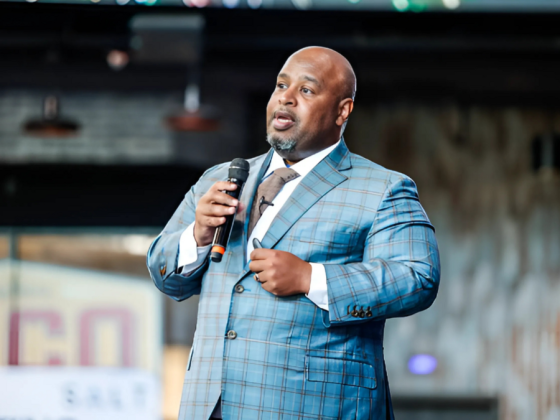
Former Clemson and pro football standout still scoring points in a different way
By L. C. LEACH III | CONTRIBUTOR
On New Year’s Eve, 1981, Clemson senior Perry Tuttle was in Miami preparing for his last collegiate football game. He was a gifted receiver headed for the NFL, but barely known outside the business of college and professional football.
 A week or so later, he heard from Marcus Allen, a running back at Southern Cal University. Tuttle expected him to say congratulations – the Clemson Tigers had beaten the Nebraska Cornhuskers 22-15 in the Orange Bowl on New Year’s Day for the school’s first National Championship in football.
Instead, Allen said, “Do you know you’re on the cover?”
Tuttle had just become the first (and so far only) Clemson athlete to make the cover of Sports Illustrated – it showed him catching the winning touchdown pass against Nebraska in his final game.
And now, 33 years later, Tuttle’s SI cover continues to open doors for him and the motivational work he does for others.
[break]
Perry, start with the SI cover of your Orange Bowl catch. How relevant was that moment to who and what you are now?
In all the time I played football – college, NFL, and CFL – the SI cover was one of the most exciting moments for me. When that happened, my whole life changed. After I quit playing football, I got involved in inspirational speaking, sports marketing and sports ministry. So far, I’ve partnered with more than 100 organizations. That catch and that cover have been with me for every one of them.
What got you into doing this kind of work?
When I was a college freshman, I went home to Winston-Salem to watch my brother Eddie compete in the Special Olympics. Eddie was born with Down syndrome, and in one of the races he was way ahead of the other runners. Then he just stopped to wait for them to catch up. I was screaming, “Run! You’ve got to win!” He won, but barely, and I just remember thinking, “I would never do that,” but seeing him perform that act of kindness introduced me to a different way of competing. I thought of winning as a one-way street, but that moment changed things for me and led me to what I’m doing now.
Was there anything besides Eddie’s inspiration that made you stay in motivational work instead of doing something else?
Yes. In our society, some of us do not have a voice, but there are also people like me who do. That is what motivates me, and I am fortunate enough to be in a position to act as a voice for people who need it.
Is it easier or harder for you to speak on a stage before a group of several hundred than it was to play football in front of 80,000 at Death Valley?
Speaking before a group is much harder. In football, if you play well and certainly if you win, people cheer and are all for the team. As a football player, there’s always the next game. In public speaking, however, your words really matter. You’ve got that one moment in front of the group to really make an impact.

You’ve been in Greenville representing a place called Generations Group Home [a home in Fountain Inn for boys caught in sexual abuse cycle]. How does the public stage you spoke of help groups like this one?
Generations Group Home was started in 1991, the year before I retired from the Canadian Football League. They’re taking teenage boys who’ve been traumatized, and as a result have started down the wrong path. Generations is working hard to steer them in the right direction. After having visited their facilities and meeting the boys, I’ve seen the positive impact they’ve made not only with the boys, but with the law enforcement system and our society. But not everyone knows that. Personally, I really want to see them win and succeed and have healthy productive lives. I also want others to become more involved and help get these boys on the right track. So this year, Generations had their inaugural fundraiser on Nov. 13 at the Poinsett Club and asked me to be their keynote speaker. I’m excited to speak to my experiences with meeting their staff and the boys.

Any particular memory stand out from the last 25 years of public speaking?
Two memories actually, but I’ll tell you this one. I was speaking on a college campus and the topic was “Unpacking.” I had a suitcase on stage as a prop and was addressing the fact that everyone carries an invisible suitcase full of things we don’t want others to see. The theme of the speech was that how you unpack your suitcase will determine how you live your life. After the speech, a young girl dressed in all black [in the middle of the summer] came up to me and said, “I want to unpack,” and pulled up her sleeve to show me all of these scars where she had tried to commit suicide. I talked to her … and a few weeks later I checked back in with one of the university counselors … and she had totally turned her life around.

So for anyone who hasn’t heard you in person, what do you try to leave people with when you have the public stage?
More than anything, I want to inspire people so that they know even though mistakes are made, life as they know it isn’t over. A really important thing I like to address is that, it’s not who you are but whose you are. Other people are looking at you, be they your son, daughter, neighbor, coach. Someone out there is depending on you.
Speaking of which, I understand that you are depending on, or hoping for, a cure for something you’re carrying in your own invisible suitcase.
I started off with glaucoma and now have macular degeneration, a condition that threatens my eyesight, but usually shows up in older adults. I found out about five or six years ago when I was playing golf with a good friend. I hit a great shot down the middle of the fairway, but I couldn’t see where it went … and at the next hole, the same thing happened. That’s when I knew something was wrong.
Is it treatable?
I’ve had 11 operations so far. The 12th one’s coming up. We’re trying different things and I’m remaining optimistic.
It sounds, though, like the illness and the speaking and everything that’s happened with you in the last 33 years relates in some way back to your football days at Clemson. Does it?
Oh, yes. Ties to those days are still very strong. My family, my relationships and my speaking engagements all tie back to Clemson because my time at Clemson did change my life. The university means a lot to me. The 1981 championship team and coach Danny Ford mean a lot to me. On the stage that I now have, I represent not just my family, but also Clemson and that ’81 team. In a lot of ways, that’s why I do what I do.