

In the first year of the COVID-19 pandemic, global prevalence of anxiety and depression increased by a massive 25%, according to data released by the World Health Organization in March.
Prior to the pandemic, the numbers weren’t exactly dreamy, either: Mental Health America found 19.86% of adults experienced a mental illness in 2019, equivalent to nearly 50 million Americans.
Some companies with a presence in the Upstate are responding to these challenges by beefing up their mental-health-related benefits to make sure employees feel supported. A February survey of more than 2,000 U.S. adults by the Harris Poll on behalf of Fortune found nearly 23% of workers say their employer has introduced new mental health services during the pandemic. More than a third of them said their companies have always offered some kind of mental health support.
Troy Styles, owner of Early Goat Coffee Co. in Greenville, said he took mental health first-aid classes hosted by the National Council of Behavioral Health to be able to deal with the mental health crises his team may face. His company also has a 24/7 phone line employees can call for any reason.
“I’ve had employees call for rides, groceries, just to talk and more. We try to be supportive without being invasive,” Styles said. “I still think the best way to make an employee comfortable on a job is to offer their reflection through inclusiveness. Sometimes a work family is the only place a person feels OK or safe.”
A straw poll of Upstate employers and employees found that several employers, including Lockheed Martin, Habitat for Humanity of Greenville County and Clemson University, offer employee assistance programs, or EAPs. Many EAPs allow employees to seek a limited number of mental health counseling sessions. Lockheed Martin, for example, offers employees and their family members eight free sessions per year.
Some EAPs allow a limited number of sessions per mental health issue or challenge and allow employees to continue to address issues and challenges as they arise. About one in four employees responding to the Harris Poll said their employers offers them. A former Habitat for Humanity employee, who wished not to be identified, said their EAP allows 10 sessions per issue.
 “If I was having an issue with work boundaries, that would be one issue [for which I’d get 10 visits to address]. If I needed to talk about a family matter, then I’d get another 10 visits,” the former employee said.
Cass Information Systems, a Missouri-based company with an office in Greenville, invites employees to call a free mental health hotline.
“It’s really nice that they offer it because a lot of times if you need help, you need help now, and most therapists these days have a waiting list and it can take a while before you can get to see one,” said one Cass employee who also wished not to be identified.
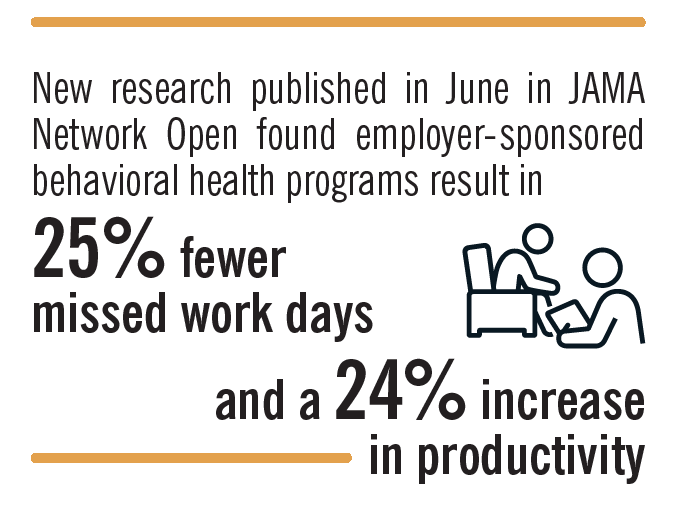 New research published in June in JAMA Network Open found employer-sponsored behavioral health programs result in 25% fewer missed work days and a 24% increase in productivity.
Researchers at Spring Health, a New York City-based EAP supplement company, studied 1,132 employees at 66 employers across 40 states over three years.
Nearly seven in 10 Spring Health users reported a reliable improvement in depression and anxiety, and it took an average of fewer than six weeks for patients to enter remission of their symptoms.






