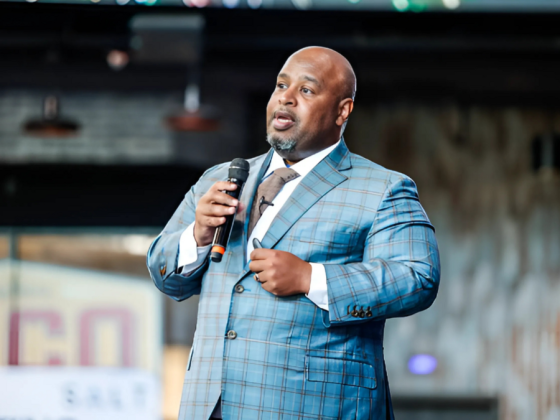
‘Accidental chamber professional’ Carlos Phillips’ journey led him to leadership of the Greenville Chamber
The Greenville Chamber of Commerce welcomed a new boss last week, as Carlos Phillips took over for previous chamber president and CEO Ben Haskew. Phillips, 47, previously served as senior vice president of operations at Greater Louisville Inc., The Metro Chamber of Commerce of Louisville, where he spent nearly a dozen years. The University of Kentucky grad’s schedule is already booked through May with four external meetings each day on average, he says.
Upstate Business Journal caught Phillips on his fourth day on the job to talk Kentucky, the first 100 days and sports teams.
[break]
How did you get here/how did you get into chamber work?
I am an accidental chamber professional. … [A friend] asked me if I would consider working for the chamber, and I laughed, because I thought all they did was shake hands, kiss babies and lie about the weather. That was 12 years ago. I fell in love with the work that we do and the value we’re tasked with delivering to the business community.
Did you know anything about Greenville before your interview?
When I lived in Atlanta, my wife and I liked to go to Asheville, to the [Omni] Grove Park Inn. We would drive by Greenville but never stopped. … I was aware that it existed. I knew Furman was here.

What are your plans for the chamber?
I didn’t inherit a broken chamber. It’s in good shape, which is almost a scary thing. You almost want to walk in to a broken system so you can come in and fix it. I’m kind of in a spot where I don’t want to mess anything up. The community and the chamber want to do more. They recognize that they’ve done a lot of good work, but they want to do more. I’m most excited about helping the Greenville business community achieve its dreams. Now, I’ve got some work to do to figure out what those dreams are, but again, I’m engaging in work that is bigger than me.

Where does that work start?
For my first 100 days, I’m going to listen and absorb as much information as possible. … As quickly as possible, I want people to think that I am from here because people do business with people they know, they like and they trust. The only way that they can know, like and trust me is I’ve got to make every effort possible to get to know and see them, and get them to trust me. There’s a piece of me that’s excited about it, but there’s a piece of me that’s nervous, too. If I don’t get to know the people here, it’s going to be my fault, because everybody here has demonstrated an interest in getting to know me.
 How different are the Upstate and Kentucky, in your opinion?
You could close your eyes and really, sometimes I wouldn’t be able to tell if I was in Kentucky or here. The states are very similar – very, very similar – but I think you could do that from state to state. The challenges are the same. What differentiates different areas are how are they are addressing their issues, because everybody has workforce issues, or almost everybody.

Has the role of chambers of commerce changed in the last decade?
I don’t think there’s been a shift in the [chamber’s] responsibility to deliver value. I think several things have shifted to change the definition of what value is. Millennials define value a little differently than the old geezers like me. Folks my age, we didn’t mind joining organizations. But millennials are not joiners, per se, they’re engagers. One of the things the chamber of today has to do is to meet business leaders where they are. It’s not a one-size-fits-all.

What does it mean that you’re the first African-American to lead this organization?
That’s not unique to Greenville. The industry is quite homogenous. Our country is browning, and if we are going to continue to be successful as a country, we’re going to have to figure how to make sure that everybody shares in the opportunity for prosperity. … There aren’t many black people in the chamber industry, period. There sure aren’t many black CEOs. Having said all that, I have no interest in being the black CEO. My only interest is to be the best CEO.
I think our search committee exercised what we would want everybody to exercise, and that is, let’s look at the qualifications. Let’s look at the skill sets. Let’s look at the qualities they bring to the table. I think if a Martian interviewed, and they felt like the Martian could do what they needed to, I think they would have hired him, selected him. I think that’s how open-minded they are, and I think that’s what we want our world to be.

How can we improve our entrepreneurial culture, build on NEXT?
Sometime over the next few weeks, you might eat a Papa John’s pizza, born first in Louisville. The founder, his dad owned a bar. It started in a broom closet of his dad’s bar. That’s what a NEXT is for. People are providing the services they need to provide so people can take that broom closet dream and potentially turn it into Greenville’s next great organization.
You’ve got to be less risk-averse. What is the average batting average of Major League Baseball Hall of Famers? 300s, and that’s the Holy Grail. That means you’re only getting a hit – if you’re the best in your business – three out of 10 times. And that’s Hall of Fame. If you’re not striking out, you’re probably not swinging enough.
And finally: Clemson or USC?
There’s one school that I’m passionate about, but I root for several folks. I’ll root for whoever. I’m a UK fan. My wife is a University of Louisville alum and we’ve been married 24 years. I’ve figured it out.