It’s been three decades since the first “ultimate driving machine” made in South Carolina rolled off the assembly line.
BMW Manufacturing has become so embedded in the fabric of life in the Upstate – and South Carolina more broadly – that it’s easy to assume the company has always been here.
To truly grasp the company’s gargantuan impact on the area, it’s important to realize how shaky the state’s economic prospects were in the 1980s and early 1990s following the wholesale collapse of the textile industry here, according to one local leader who had a front-row seat to what unfolded 30 years ago.
BMW Manufacturing places a big bet
 There were 40,000 unemployed workers in Spartanburg County in 1991 when David Britt was first elected to County Council. Of that number, 25,000 had lost jobs in textile manufacturing in a county with a population of about 200,000.
With per capita income less than $17,000 a year, a county government that was broke and thousands of county residents running out of hope, Britt ran on a platform of economic development and job creation.
When then-Gov. Carroll Campbell began assembling a team the following year to vie for BMW’s first manufacturing facility to be built outside Germany, Britt understood the magnitude of the opportunity that recruiting such a company to his county would create.
He said it was a big bet with a huge potential payoff.
When news came in 1992 that South Carolina had edged out Nebraska to be the site of BMW’s new American factory, attitudes in Spartanburg County went from desperation to jubilation, Britt said.
“I have never felt the feeling I encountered when we finally landed BMW,” he said. “When that happened it was such a relief because we had hope.”
Another native South Carolinian, state Secretary of Commerce Harry Lightsey remembers the impact of BMW’s announcement that it had chosen his home state for what would ultimately become the company’s largest manufacturing facility in the world.
He said companies around the world paid attention when BMW, a global company known for exacting German standards of quality and precision, chose South Carolina.
Lightsey said this sent two important signals that continue to resonate and underpin the state’s economic success.
The first signal told the world the state was a good place to do business, and the second told the world that BMW believed South Carolinians capable of manufacturing at the highest level.
“The rest of the world took note,” he said. “That has really fueled a lot of things.”
The transformation
 With direct investment of nearly $14 billion, a workforce of more than 11,000 associates and an estimated annual economic impact of about $30 billion, BMW Manufacturing’s effect on the regional, state and national economies has been transformative.
But behind all those staggering numbers of economic impact are the tens of thousands of personal stories from the people whose lives have been improved no less profoundly.
Tim Denkers, who started work the day Plant Spartanburg opened on June 6, 1994, found not only a career but a new family.
Although he could have already retired, he said he stays on because he enjoys the work and the people.
Denkers has served in many roles over his three decades with the company, but looks back with special fondness to the early years when he was part of the team that installed the engines in the Z3 roadster, the first model solely manufactured outside Germany at Plant Spartanburg.
“I was telling everyone that I was putting the heart of the Z3 in,” he said. “It’s been very fulfilling knowing there are so many cars around the world (that) I helped impact.”
Another 30-year associate, Nathalie Belk started work at BMW in July 1994 and was one of an initial 12 Clemson University graduates recruited by the company.
Born in France, her family was brought to this country through her father’s work for another global company that chose to set up shop in South Carolina — Michelin.
Thanks to her father’s example with Michelin, Belk said she understood the career opportunity working for a company like BMW represented.
“For me, it was super exciting when BMW came to Clemson,” she said.
While she has worked at Plant Spartanburg for three decades, her husband is approaching his 30th anniversary working for one of the company’s suppliers. She said their careers have profoundly impacted their family and calls their two sons, both of whom are now grown, her “BMW babies.”
Like Belk, Denkers said working for the company has benefited not only his family, but the thousands of families of other associates who’ve worked there.
“I feel very blessed,” he said.
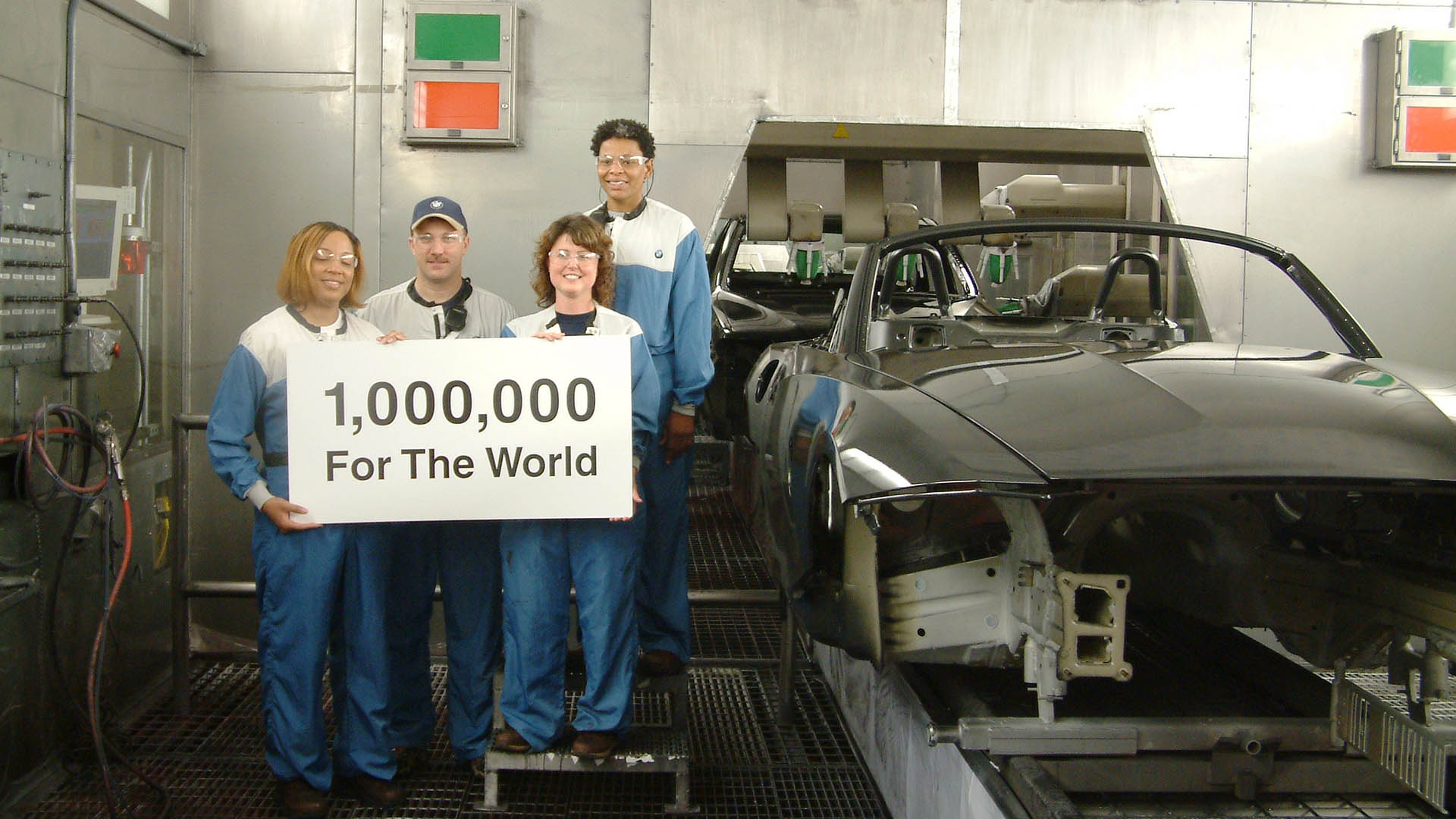
Plant Spartanburg milestones
- Sept. 8, 1994 — first car completed, a 318i
- Feb. 28, 2006 — one millionth car completed, a Z4 M roadster
- Jan. 12, 2012 — two millionth car completed, an X3 xDrive 35i
- March 24, 2015 — three millionth car completed, an X5 M
- Sept. 8, 2017 — four millionth car completed, an X3 xDrive M40i
- June 4, 2020 — five millionth car completed, an X6 M
BMW Plant Spartanburg by the numbers
- The plant’s more than 11,000 associates manufacture an average of 1,500 cars a day
- The plant produced 410,793 vehicles in 2023
- Currently at more than 8 million square feet, the plant produces X3, X4, X5, X6, X7 and XM models, among others.
- Other models produced include the 318i (1994-96), Z3 roadster and variants (1995-2002) and Z4 roadster and variants (2002-08)