A company that first made its mark in the mountains of Mongolia is now a staple of downtown Greenville where it continues to combat diseases and epidemics on the local, national and global stages.
Rymedi (pronounced “remedy”) has become increasingly recognized for the speed, efficiency and effectiveness of its cloud-based disease testing and treatment workflow management solution. Designed to be patient-centered and user-friendly, Rymedi’s Connected Healthcare Platform detects, treats and monitors diseases on a large-scale basis. It also can provide demographic profiles of a disease state while maintaining the anonymity of individual users.
Due to vigorous collaborations with government entities and private businesses, Rymedi is becoming a formidable economic engine in the Upstate.
“We have discovered that there are three tenets to delivering health and wellness to the market: occupational health protocol, world-class testing and treatment, and a digital platform that enables these transactions to happen in a seamless fashion,” said David Stefanich, co-founder and chief executive officer of Rymedi. “By marrying these three legs of the stool, we’ve developed wellness programs that can be applied to any disease state. Over time, we’ve optimized the workflow and maximized the impact in the wellness market.”
Rymedi’s health platform was created in 2018 as part of a World Health Organization and Onom Foundation initiative to eradicate hepatitis C in Mongolia, which at the time had the highest infection rate of hepatitis C in the world.
“Dr. Jason Cross, our other co-founder, had connections to the Onom Foundation in Mongolia,” said Stefanich, whose company was originally based in Raleigh, North Carolina, but moved to Greenville in August 2019. “We worked with Onom to define and design how digital workflow and disease management eradication could be executed. This program is still active today, and Mongolia is looking to become the first country in the world to entirely eradicate hep C.”
Rymedi’s results in Mongolia and elsewhere are due to its health care platform, which uses state-of-the art blockchain technology to enable mass testing and treatment with speed, ease and minimal staffing. The platform has also evolved into a valuable tool in the fight against COVID-19. It can be quickly implemented and create workflow solutions that enable businesses, colleges and communities to thrive again.
“Rymedi was formed to quell the hepatitis C epidemic in Mongolia,” Stefanich said. “But we saw the immense value of how a digital workflow platform could systematically test and treat an entire country for an infectious disease. For us, COVID-19 was just another disease that we had to overcome. However, the pandemic proved what we already knew to be true, that investment in connected health care is vital.”
The company is currently working closely with the City of Greenville, SCBIO Life Sciences Industry, ARCpoint Labs, SiteLabs Global, Premier Medical Laboratory Services and LabTech Diagnostics. One of its highest profile customers is Clemson University, which used the Rymedi platform to help decrease its COVID cases among students, faculty and staff by 95% (see related story) through on-campus testing.
“These connections have led to groundbreaking conversations about post-pandemic health innovation – accelerated by connected health – with well-respected leaders such as South Carolina Gov. Henry McMaster and Clemson University President James P. Clements,” said Stefanich, whose company consists of 17 full-time employees and an additional 15 contractors. “We believe Greenville must revitalize entrepreneurship and innovation to become the next hub of technology development. I think Upstate South Carolina is going to be the lynchpin that catalyzes life science growth across the Southeast.”
Clemson/Rymedi testing collaboration helps turn the COVID tide
When the Fall 2020 school year began, Clemson and many universities across the nation experienced a surge of positive COVID-19 cases shortly after students returned to campus. Clemson’s initial mass-testing, featuring the intrusive nasopharyngeal swab, was cumbersome and time-consuming. Students, faculty and staff had to wait in long lines, and it took a large team to facilitate the slow-moving procedure.
On Sept. 8, 2020, Clemson joined forces with Rymedi and quickly set up workflow digitization and automation of test preregistration, administration and reporting. The result? On Sept. 11, approximately 1,160 students and employees were tested in one day. And on Sept. 12, that number increased to about
1,800. Since then, the university – which has an enrollment of more than 25,000 students – has implemented weekly mandatory testing resulting in a 95% reduction in positive COVID cases. Now, it takes only about 15 personnel to test more than 5,000 people a day with an average waiting time of less than five minutes.
Clemson University Chief Strategy Officer Robert Donato said that initial conversations with Rymedi came about as the university was trying to manage the information flow of test results with its medical partners at Prisma Health and the Medical University of South Carolina.
“They were both great partners, but early on we identified the need for a dedicated solution for the data we needed, and the internal systems of our medical partners – while ideal for them – weren’t necessarily the right solution for us,” Donato said. “Rymedi’s technological expertise in handling large amounts of medical information in non-hospital settings and their ability to tailor a solution to our needs was vital to improving the information flow.”
Donato said that the “game-changer” for Clemson’s testing efforts was a switch from swab testing to saliva testing that came in conjunction with the development and launch of an on-campus laboratory certified by the Clinical Laboratory Improvement Amendments (CLIA).
“Rymedi played an important role in executing the barcode system and improving the information process there,” Donato said. “And the combination of the CLIA lab with rapid turnarounds for PCR (polymerase chain reaction) testing and Rymedi’s back-end system allowed the university to quickly move from test to result to action. There’s no question that our ability to quickly identify positive individuals and restrict their access to university facilities helped mitigate spread.”
Rymedi co-founder and CEO David Stefanich has several ties to the university, including completing an executive education program in the business school and becoming an advisory board member of the Corporate Partnerships and Strategic Initiatives.
“I was at a PGA event with (Clemson President) Jim Clements, and he started introducing Rymedi as the company that helped save Clemson’s football season,” Stefanich concluded. “I have a football signed by Dabo (Swinney) up on a shelf here. Being a huge fan and being able to be a part of this was a big deal to me. I knew we could impact lives, but the way the Upstate has embraced us since moving the company here from Raleigh has absolutely exceeded our expectations.”
Rymedi’s blockchain approach
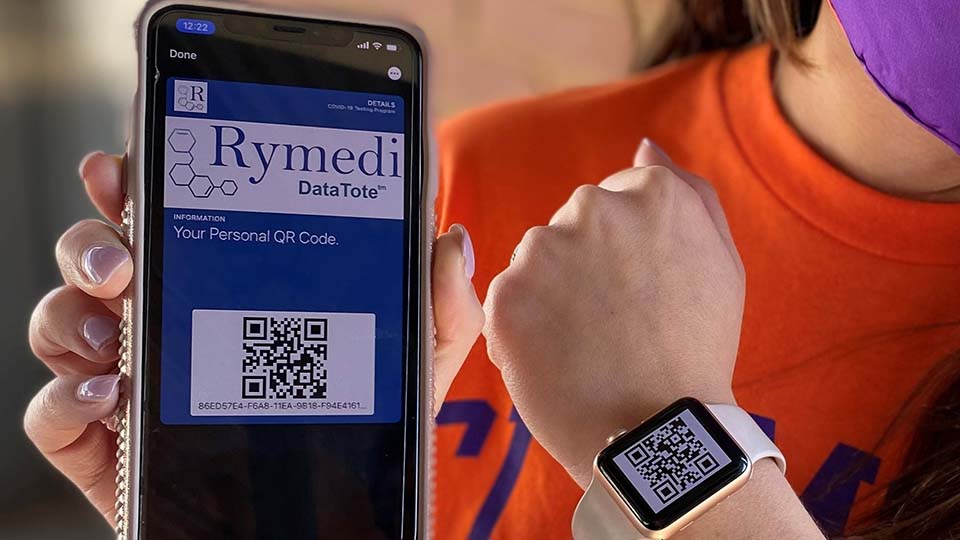
Rymedi built its Connected Healthcare Platform using blockchain technology that is designed to detect, treat and monitor diseases. Users can access their healthcare profiles online using a smartphone, smart watch or any web browser. Rymedi encrypts the data and strategically stores the information securely on separate networks in blockchain, which is essentially a digital ledger. Users can then control who can see and edit their health information, which is stored in different blockchains that make it virtually impossible to hack.
– Source: Rymedi Inc.