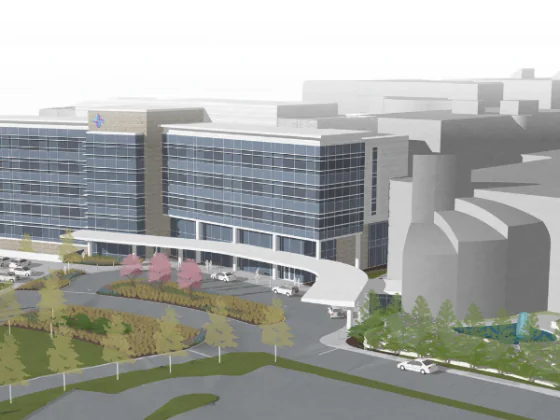
Emergency rooms are notorious for potentially long waits. Doctors David Brancati and Jason Blasenak are former emergency room physicians seeking to provide another option with EmergencyMD, a freestanding emergency physician practice at 2498 N. Pleasantburg Drive in Greenville.
A visit to the ER three years ago – as a patient – inspired Brancati to search out a different way to deliver urgent care. The consequence was EmergencyMD, Brancati’s and Blasenak’s newly launched effort to fill the gap between traditional urgent care and emergency room services.
Brancati sat down with UBJ recently to about the new venture.
What inspired you to open EmergencyMD?
Several years ago I had severe abdominal pain and thought I had appendicitis. It was much worse: a perforated intestine. I had surgery and survived, but ended up in the ICU with a bad infection. I spent six months in and out of the hospital and had 12 surgeries. I was vice chair of an emergency department and I got a real glimpse of the care I was giving at the hospital. At one point I waited eight hours for a Tylenol. I learned that the system is not working well.
How did you go about changing the system?
I told my wife that I hated the care I rendered to ER patients. They’re angry when they get to us [doctors] because they have to wait, and we’re angry because they had to wait. Waiting in an emergency room is dangerous; you don’t know what’s wrong. So Jason and I set out to follow an urgent care model, but with comprehensive services. I drew in what I would do differently.
EmergencyMD is an independent facility. How did you initially address cost?
We designed the facility to be institutional-grade with 10 treatment rooms that are just like trauma bays in an ER and two procedure rooms, but paid attention to the pennies. We found overstock or refurbished equipment, like a CAT scanner that would fit our clinical diagnostic needs, but not cost as much as an $8 million, research-grade scanner that a hospital would own.

What comprehensive services do you offer?
We can treat anything short of a life-threatening emergency – like a heart attack or threatened limb – you would normally go to the emergency room for. We have a CAT scanner, X-ray, a full lab, ultrasound and trauma, emergency and ICU-trained staff. We are trying to create a better experience. Our lab can give us results in five to 10 minutes and CAT scan results in 10 minutes. Through a picture archiving and communication system (PAC), we can consult with specialists like orthopedists, neurologists or radiologists. We will soon have a compounding pharmacy and dentist on site. Here you’re not somebody else’s problem, you’re our challenge. As far as I’m aware, we are the area’s first private practice of emergency physicians.
 Are there specifics that make your facility unique?
Our building has 42-foot ceilings to increase the fresh air turnover for the HVAC system and a “live wall” with plants as a natural filter that pulls air through. The nurse’s station is open so we can see patients and I can see a patient in the waiting area. We also created group seating rather than rows and offer a snack area.
What cases have you encountered thus far?
We have had patients coming in daily and have treated severe pneumonia and respiratory infections along with sports physicals, fractures, viruses and reattaching a crushed finger. We are preparing that we may see up to 60,000 people a year.
Your model is to charge private practice rates rather than urgent care or hospital rates. How does that work?
We bill as a doctor’s office, so we’re a more cost-effective option than the ER. As far as insurance, everything matches. If we take your insurance, our pharmacy takes your insurance. Under the urgent care model, they bill at a higher copay for a global charge, whether you’re there for nothing or something serious.

How can you see patients so quickly?
In emergency medicine, Jason and I have focused on processes. If volume increases, we would put a provider in triage to begin to get orders written, charts started and treatments running right away. You’ve got to do a lot of things in parallel. We use a team approach, and in triage, sometimes the doctor, nurse and registration see a patient all at the same time. Those are common practices used in emergency medicine that I’ve never seen used outside a hospital.
Describe your focus on quality care.
Some people are being seen within two minutes of walking in the door. We are an independent practice; therefore, we refer to the best doctor for you, period. Large health systems refer within themselves. If the best doctor’s in Charlotte, I’m referring you there. We are also members of Regional HealthPlus, so we are held to the same quality standards as a huge health system.
We’re going against the grain; while everyone is being bought up, we’re the entrepreneurs going on our own. We say that everybody who walks through here needs to be treated like your mother.