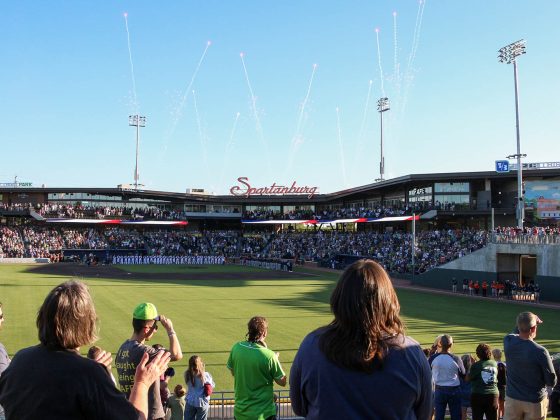
George Fletcher has had a long and successful career in the Upstate, joining Environmental Dynamics Inc. in 1975 and going on to found the Fletcher Group, an environmental engineering firm, in 1993. In addition to career success, community involvement has been a priority, and he has served as chair of the Greenville Chamber of Commerce, co-chair with his wife of the Greenville County United Way campaign, coordinator of the Vision 2025 process and chair of the committee that brought the baseball stadium downtown.
At 68, Fletcher retired last year, but he continues to work with organizations such as South Carolina’s Council on Competitiveness, where he was the first executive director, and serving on a variety of boards.
“Whether it’s business or nonprofits,” he said, “satisfaction is making things happen.”
Where did you grow up and what brought you to Greenville?
I grew up in Kansas City and went to the University of Kansas. I worked for Owens-Corning Fiberglass in Toledo, Ohio. They moved me to South Carolina in 1970 to work at the Anderson plant and go to graduate school in environmental engineering at Clemson. I met my wife at Clemson, and we got married in 1972. We moved back to Toledo and then Rhode Island. Finally in 1975, I joined two guys I was in grad school with (Larry Blackwell and Joe Busby) to start an engineering company in Greenville.
What prompted you to go out on your own and why Greenville?
We had a great experience at Clemson, and we loved the Upstate. The two guys who started this with me both had Ph.D.s in environmental engineering, and at the time it was one of those fields just exploding. We thought it was a great opportunity.
What was the business and what did it provide?
It was Environmental Dynamics Inc., which we shortened to EDI. It was an environmental engineering company, providing consulting and engineering services mainly for water and waste treatment. We were working with big textile and synthetic fiber companies like Dow, DuPont and Allied. It was a good business.
It was an incredibly entrepreneurial company, spinning out five or six companies. One of the partners, Larry Blackwell, spun Datastream [now Infor] into a legend. That’s one of the reasons we sold – I wanted an engineering company and Larry wanted to build a software company. We sold EDI to a subsidiary of Wisconsin Power and Light, RMT, in 1984.
Was the sale a good move?
We had a lot going for us, but we didn’t know anything about raising capital, management skills. But those were solvable problems. EDI did very well and we learned a lot, but selling was the worst decision I ever made.
Did you stay on with the company?
I did, I was regional president. We parted ways in 1992, and I started The Fletcher Group Inc. If selling to RMT was the worst decision I ever made, then starting The Fletcher Group was the best, short of marrying my wife and moving to Greenville.
How did the Fletcher Group differ from EDI?
By then, many industrial waste treatment problems had been solved, so there was more hazardous waste remediation work, groundwater remediation work. I wanted to go back to the old EDI model, growing to a certain size and then spinning out companies. We had four different companies at that time, the best of which was a waste treatment plant that belonged to Dow. We turned it into a contract waste treatment plant, bringing in waste to treat rather than it coming through a pipeline from a plant.
What was the fate of the Fletcher Group?
In 2006 it was bought by a Dutch chemical company after a five-year buyout agreement. It became Synterra, and that same year I became the executive director of the South Carolina Council On Competitiveness, a nonprofit corporation whose mission is to drive a long-term economic development strategy for South Carolina built around the concept of industrial clusters.
What prompted your switch from engineering to economic development?
I’d been peripherally involved for a long time, working with the Chamber and other groups. It was fun to do something different from engineering.
Explain more about the ideas behind the S.C. Council on Competitiveness.
Michael Porter, a Harvard professor and foremost economic strategist in the country, advocated the idea of clusters: steel in Pittsburgh, technology in Silicon Valley. Classic clusters bring efficiency, entrepreneurship and innovation within the industry. We have clusters here – textile companies and now automotive.
Porter made eight recommendations, and our state, without ever adopting them as a formal economic development strategy, has made remarkable progress. Porter’s recommendations made sense. This was a different strategy from what we had historically done, and we accomplished a lot.
What are your plans for the future?
I’m on the S.C. Research Authority Board and the ReWa board. The Rotary Club of Greenville will be celebrating its centennial in 2016, and they’ve had a heck of an impact on Greenville, so I’ve been working with that. I’m still engaged with clusters, and I hope I will be until I can’t be. I really believe in what we are doing.