After 18 years in office, Greenville Mayor Knox White still has his eyes on the future
On any given day, Greenville Mayor Knox White can be found walking down Main Street, stopping to talk to visitors and keeping an eye on the many projects the city has underway.
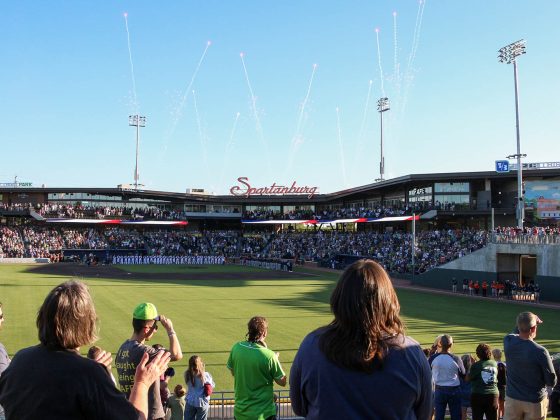
And if you happen to strike up a conversation with White about anything, the topic will soon turn to downtown Greenville. It’s an obvious passion – White calls it his “only hobby” – and permeates his obvious enthusiasm about the crown jewel that has been his decades-long personal focus. White has spearheaded such projects as the removal of the Camperdown Bridge and creation of Falls Park, the restoration of the Poinsett Hotel and Court Street and the wooing of new retail such as Mast General Store and a baseball stadium to downtown.
White, a Greenville native, says his goal is for Greenville to be known as “the most beautiful and livable city in America.” His interest in government dates back to his tenure as student body president at Greenville High School. He served as a campaign manager for former S.C. Gov. Carroll Campbell before winning election to the Greenville City Council in 1983.
In addition to serving as the city’s mayor (a part-time position) since 1995, White is also a partner at the law firm Haynsworth Sinkler Boyd, where he heads the firm’s immigration and customs practices.
UBJ recently sat down with White for a conversation.
 Why did you decide to run for mayor back in 1995?
I’m a Greenville native but I’ve also lived in Washington, D.C. I was on council for many years and saw a continuing theme there on growth and quality of growth. Greenville’s going to grow, and how do we control that growth? It’s still very much what I’m about and I want us to learn from larger communities – areas like Atlanta and Charlotte – and to learn from their mistakes and do something different. It truly stuck a chord in 1995 that Greenville could be different. It’s about quality of life here and finding balance.
Did you accomplish what you set out to do then?
Yes, I think so. We’ve changed the mindset at City Hall. It took awhile. We should not have an attitude that ‘everything goes.’ We have high standards and make no apology for it, whether it’s downtown or in neighborhoods. I’ve been successful in Greenville because the residents support it and that’s not always true in other areas.
There’s an election in 2015. What happens if you’re not mayor of Greenville after that?
I treat every term as if it were my last anyhow, and I maintain a sense of urgency as I watch projects go through the process. I do practice law and that’s very different from my city duties, so I would probably focus even more on immigration law. I would still be involved, though, in the community. Long before I was mayor or served on City Council, I was involved in political campaigns, youth organizations and chamber projects.
Housing is something I care a lot about. So I would also probably involve myself in Homes for Hope or other organizations that offer affordable housing options.
What’s your daily routine like?
I usually spend my mornings at the law firm, and then beginning around noon I usually have a meeting and start my day at City Hall. It’s good in that it sort of clears my head and lets me focus on something completely different from working with work visas and business immigration law.
It’s not always that neat, of course, as there are sometimes city activities such as ribbon-cuttings and meetings that happen in the morning that I attend, and some days I’m mayor for a full day.
What does your job as mayor entail?
In the afternoons it’s generally meetings. Bringing people together and promoting, sometimes cajoling, but always encouraging. It’s about connecting people together and helping with opportunities they might not know about. I can also be a good sounding board. I check on projects constantly to make sure we’re meeting deadlines. It’s the people who have started the businesses and have made the investments that have made downtown Greenville a success.

Who was your mentor or role model?
I’ve always been interested in government and politics and working through the political world early on. In ninth grade, I worked as campaign manager for Carroll Campbell. He lost that year, but I was his sole campaign worker and ended up forming an ongoing relationship with him and ended up serving in Washington, D.C., with him while he was in Congress. A lot of the way I manage my political world, I attribute to him.
Any future political ambitions?
No, not really. I was the GOP nominee for Congress in 1988. I came back from D.C., and as interested as I am in politics, the mayor role changed me pretty profoundly. Now, I tolerate the politics, but I’m far more interested in the governance and the role of the city and mayor. Urban design and architecture are truly my passion, with pedestrian friendly streets and green spaces.
As mayor, being part-time, I need to be careful how I spend my time, and I decided early on that I wasn’t going to travel to meetings in Washington and national conferences. Instead, I spend my additional time when I leave the city on areas of urban planning and architecture to learn the best practices of urban development. I think it’s important to spend time on the things that you can apply to your city to make it more successful.
What’s the best aspect of your role as mayor?
The mayor role can be creative. You can see what you produce and offer vision and encouragement towards that vision. That’s exciting stuff.
By educating myself – reading books, attending seminars and talking to people in the urban planning field – I gained confidence over time that I can do this. I keep a copy of Jane Jacobs’ book on urban planning [“The Death and Life of Great American Cities”] on my desk all the time.
Most great cities have mayors who take an active role and act as a spokesperson for good urban design. If we don’t speak up, then who will? You’ve got to take that role.
Looking forward 10, 15, 20 years, where do you see the city headed?
We have to keep moving the ball forward and keep focusing on quality. We can’t stand still. I think our biggest quality is the [Reedy] river. It’s what distinguishes us; it’s our Greenville brand to the world. It’s safe and clean and has a good mixed use of development. We need to keep moving upriver around the Kroc Center and build a new park area as part of the new Westside planning. The west side has always sort of been Greenville’s backyard, but that’s really the next area we need to focus on.
We also need to focus on corridors such as Pete Hollis Boulevard, Augusta Road and Stone Avenue and take some of the same philosophies that we did with downtown and apply them to those areas. Even with sign ordinances and design standards, we still have a ways to go with that.