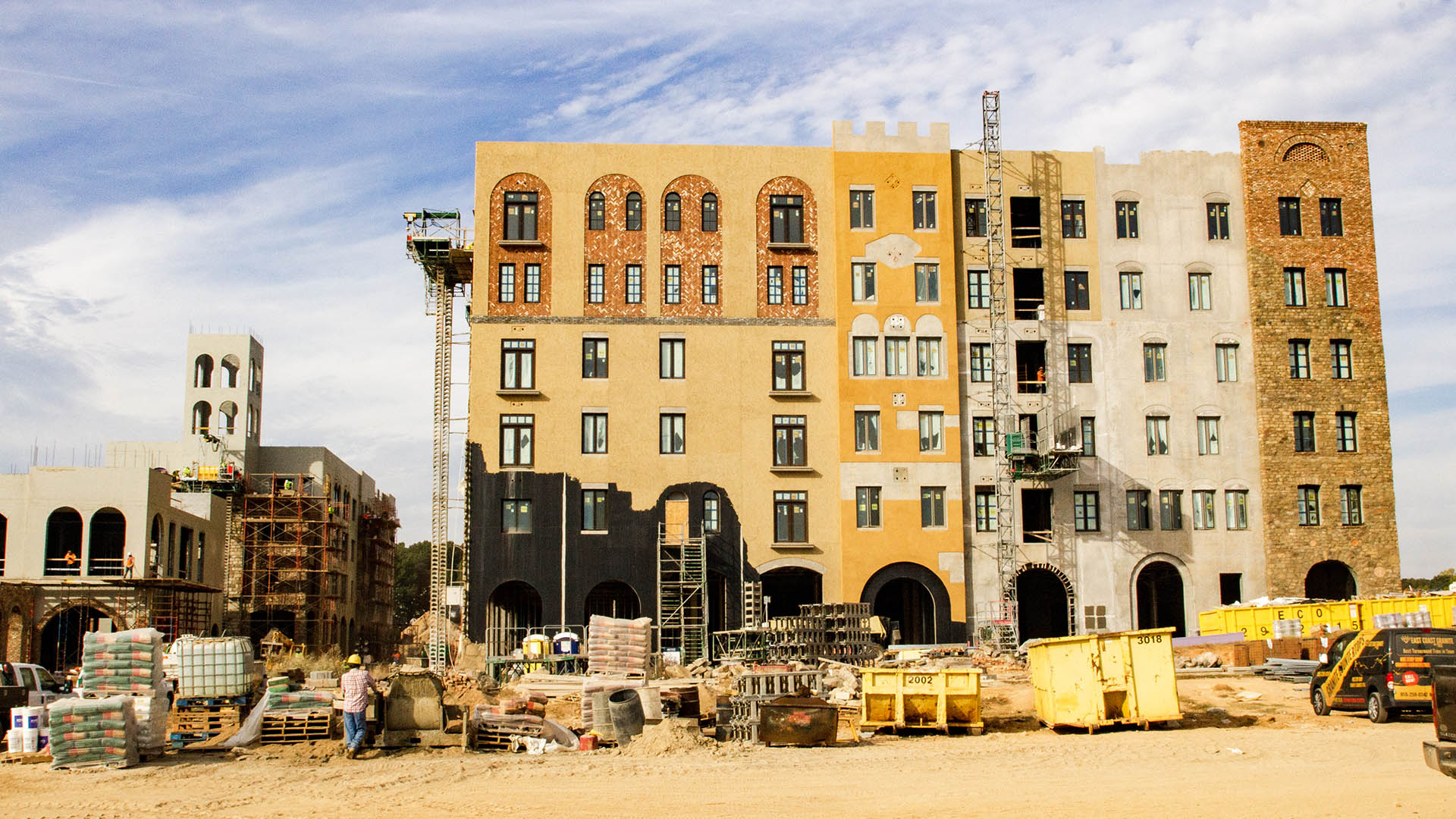
Perhaps the greatest collection of old-world Italian art and artifacts in the entire state of South Carolina is currently sitting out in the open over a field of dust and mud in Mauldin, just a stone’s throw off Interstate 385.
But the curator of this collection is not worried about them getting lost or stolen.
For one thing, average onlookers would likely not realize the significance of what they were seeing, even if they walked up close. The art pieces and artifacts sit in wooden crates. Some are bundled in protective padding or plastic wrap. Others are stored in shipping containers, the doors of which are locked tight. Not to mention, most of the art pieces out in the open are so massive — heavy bowls and pots, gigantic stone statues and carvings — that one would need construction equipment to even move them an inch.
Luckily for Phil Hughes, the curator of this art collection, he has an entire construction crew at his disposal.
“Inexpensive is a great goal — I understand it — but it’s harder to create something of real beauty, to put in the time and effort needed to bring out that beauty in a project this size,” Hughes said, his boots kicking up dust as he strolls around the artifacts.
Off behind him rises the still-incomplete bell towers and buildings that make up BridgeWay Station, the immersive, master-planned village that has been in the works for years.
Hughes, the founder of Hughes Investments, aims to transform the once-empty space into more than 450,000 square feet of development, including retail, restaurants, office space, multifamily residential, event space, pool, market area and more, plus a pedestrian bridge that will span the highway.
Coming with a price tag of about $150 million for its first phase alone, the project, which is spearheaded by Hughes Investments alongside McMillan Pazdan Smith, Johnston Design Group and Harper General Contractors, is set to be complete in early 2023.
But for now, Hughes is more interested in discussing what he calls “the fairy dust of the project.”
“We call it fairy dust because that’s really what it is: a little bit of magic that we sprinkle all over the project,” he said, referring to the art he plans to incorporate across the entirety of the development.
It’s all collected here, right on the construction site. From carvings of lions dating back centuries, to stonework that was made by hand in the era of Michelangelo and Da Vinci, to roof tiles that date back to 1763 (literally: The date was carved by a fingernail into the terracotta before it dried), the fairy dust makes BridgeWay Station a unique feature in the Upstate.
But although BridgeWay Station may be unique for its decidedly Old World Italian aesthetic, its focus on incorporating art is by no means a rarity. Developers across the Upstate have turned to art as a key way to create a unique identity, a unique brand, for their projects.
Commercial real estate art: Out with the old
Take the upcoming Hotel Hartness, a planned four-star boutique hotel featuring 73 suites, a conference center and ballroom that will open in 2023 in the 444-acre Hartness urban village.
The hotel project would already be unique for the fact that it is growing as an offshoot of the childhood home of Hartness CEO Sean Hartness, a facet that he hopes will create a welcoming, home-like atmosphere for the project as a whole. But it is also unique for the hyper-local focus on the entire design, led by architect Jim Culpepper. This includes adorning the project inside and out with work by local artists, which is curated by Greenville-based Art Houzze, a business dedicated to connecting artists and art enthusiasts.
“We really didn’t have to go far to find fantastic artists,” Hartness said. “With that in mind, we want to keep this as a dynamic, active, curated collection. We’re not going to put it all up there on the walls and just leave it. We want this to be a rotational, living experience.”
Both Hughes and Hartness believe developers would do well to keep in mind that the expectations of guests and patrons have changed. Back in the 1990s, for example, a hotel’s food and beverage program could be as simple as tacking on a Bennigan’s or Applebee’s to the property, and that would suffice. Nowadays, guests expect a high-quality, unique dining experience — farm-to-table, local ingredients and so on.
So too do they expect a space that is deliberate about its art and aesthetic.
In the age of Instagram, when every guest is an amateur photographer looking to share their experiences with the world, the same old cookie-cutter art prints used in every chain hotel no longer cut it, according to Prime Reality, a full-service commercial real estate firm serving the Southeast.
“Art enhances the way we live, work and play,” the firm said in a statement. “It can enhance communal areas, office projects and retail development. Developers are using art to brand a property and create a vibe that matches the culture.”
Some projects have taken that notion and run with it to the extreme, such as the recently opened Grand Bohemian Lodge overlooking Falls Park in downtown Greenville. The lobby of the hotel is not so much a lobby as it is a museum, with art on display and open to the public year-round. This curated collection of paintings, sculptures and jewelry come from the Kessler Collection.
“Grand Bohemian started back in Orlando in 2001, that was our first hotel, and it was all about art,” said Mark Kessler, president and COO of Kessler Collection Design and Development. “We’ve carried that theme all the way through to today. My dad (chairman and CEO Richard Kessler) is an avid art collector — our whole family is. So we put our personal art collection into the hotel to really make it special. That’s what sets up apart from everyone else.”
In with the old

When it comes to Hughes and his “fairy dust” of Italian art, the goal is not merely to collect artful trinkets, such as the ancient olive presses, stone family crests and even old manholes that adorn BridgeWay Station. Instead, he wants to harness these artifacts to create a truly immersive experience that cannot be replicated anywhere else.
“Run your fingers along the grooves of this pot here,” he said, stopping to brush his fingertips over an old terracotta pot. “See these small ridges? That’s from someone’s fingers molding that hundreds of years ago. You can feel what he felt. It’s like touching the past. We can bring that here, to this project. To me, that’s magic.”