By now, it’s practically a cliche to say the pandemic changed everything, including how we work.
“Remote work,” “flex-schedules,” “hybrid” models: the buzzwords fill the air. And yet, the practical implications have been front and center in the minds of those responsible for designing the workspaces of the future.
Locally, it’s a question for K.J. Jacobs, principal at McMillan Pazdan Smith Architecture, the firm designing the new headquarters for United Community Bank in downtown Greenville.
Jacobs does not subscribe to the theory that the proverbial sky is falling when it comes to office settings.
“Just because we can do something doesn’t mean we should,” Jacobs said. “Great organizations have great cultures, and I just don’t know of an organization that has a great culture that operates with a completely dispersed model.”

Companies still buying up space
As someone who designs workspaces, Jacobs has a dog in the fight, but the actions of a few behemoths seem to back him up.
Take Google’s recent acquisition of a Manhattan office building for $2.1 billion, one of the more overt indications that even if work remains on a flexible model, the centralized office building is not yet a dinosaur.
Google is not alone. Private equity firm KKR & Co. just paid $1.1 billion for a San Francisco office building that will be leased out to Dropbox.
“If they’re sending everyone home for good, why are they buying all this real estate?” Jacobs wondered.
What will change, Jacobs said, is the design of these spaces. It could be argued the world of office design is merging into its next major era — from the cubicle-driven model of the 1980s to the open-concept plans driven by Silicon Valley in the early 2000s, to a new era that resembles a hodgepodge of transforming ideas.
Community-driven designs
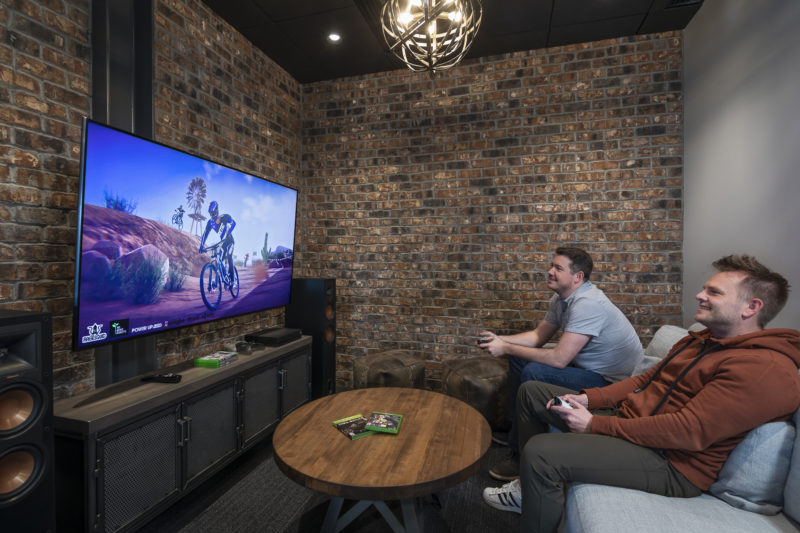
“We have seen a lot more focus on community-driven spaces,” said Katie Skoloff, principal designer and founder of In Site Designs. “We’re seeing smaller workspaces brought together by more community areas where people can gather and work in different spaces. It’s not necessarily everyone in the same space at the same time, but an overall design where they can get up from their desk and move to a different atmosphere.”
The whole point of adding these spaces is to drive collaboration and personal interaction.
“I think personal space is going to continue to shrink,” Jacobs said. “Even at the executive level, the folks are saying they don’t need a large executive office. They go from meeting to meeting and are on the road, but they do need a place to close the door that can fit a few people, though probably not a nine-person conference table that’s only used 3% of the time.”
Adaptability
Skoloff sees furniture and space design as key to office design moving forward. The rise of so-called pods will continue, while furniture will no longer be as fixed as it was in the past.
“The ‘cubicle’ spaces will all be changed so that everything moves a bit,” she said. “Your chair moves, your desk can go up and down, people can adapt the space as they see fit. Individualizing a space will be easier than ever before.
In a “war for talent,” as Jacobs calls it, perhaps the most significant driver of ensuring employees come to the office space and grow a shared culture is to simply make the offices more inviting.
“One of the biggest things is a renewed focus on the physical environment,” Jacbos said. “That’s where you start to add value and give them a reason to want to come into work.”