

With the explosive growth of the film industry in Georgia and, more recently, in North Carolina, it would be easy to overlook South Carolina’s small but vibrant film community and relegate it to a supporting role in the Southeast’s burgeoning entertainment economy.
The reality is the Palmetto State has played an important role in cinema history going back decades with iconic films like “Deliverance,” “Forrest Gump” and “The Big Chill” and, according to S.C. Film Commissioner Matt Storm, that role continues and could actually expand, given the right incentives.
Modest investment, big dividends
According to Dan Rogers, senior project manager for the S.C. Film Commission, the state’s cash rebate program paid immediate dividends in 2006 when signed into law and helped land the George Clooney film, “Leatherheads.”
That project was an economic boon to Greer and the surrounding area. According to data compiled by the film commission, the $63.3 million film productions spent in the state that year generated $120.3 million in economic activity.
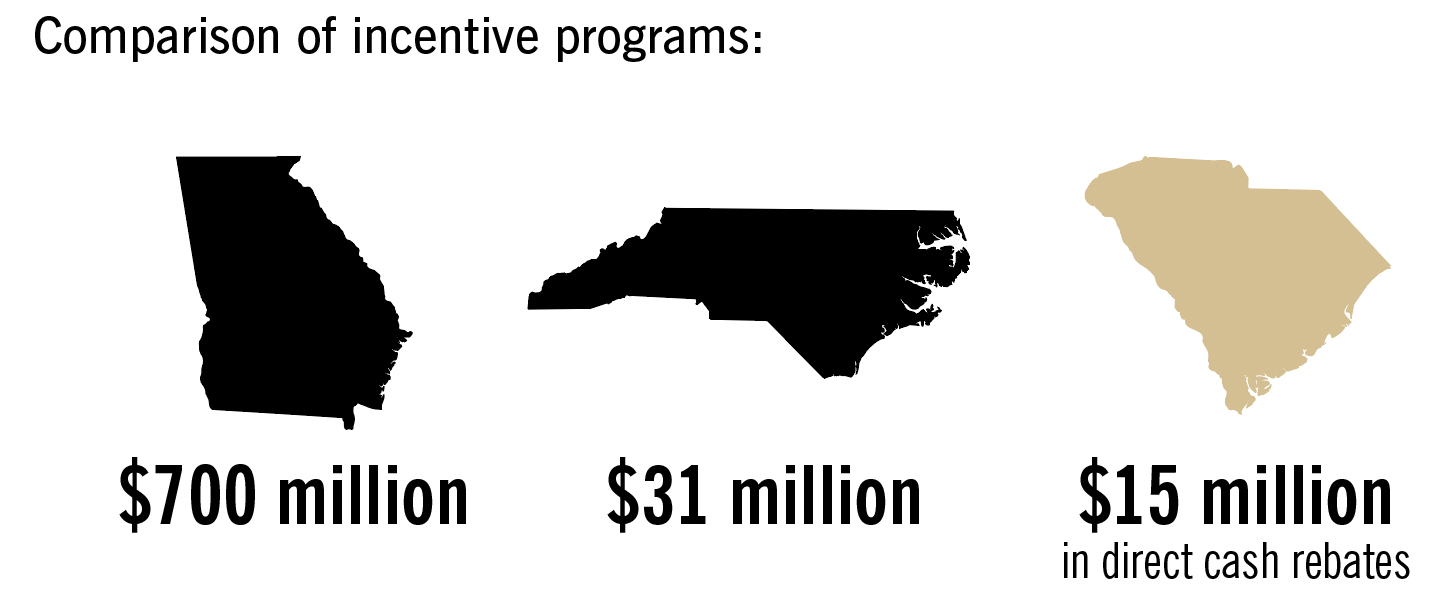
Unlike Georgia’s massive $700 million in tax credits targeting the film industry, South Carolina’s program offers a 25% rebate in wages paid to in-state workers and 30% on in-state supplies for productions shot in the state. Those figures drop to 20% for out-of-state wages and 25% for out-of-state supplies.
“That’s local, good spend in South Carolina,” Storm says.
But the state’s comparatively small investment in film incentives means many projects get turned down.
In 2021, the film commission had to say “no” to 29 projects representing an estimated investment of about $350 million because the state’s investment budget was already committed, Rogers says. The consensus of those working in the state’s film industry seems to be that state leaders need to devote more funding in order to compete.
Storm says film projects can produce a wide variety of economic activity in the state from hotel rooms and meals for crew, to supplies and skilled labor for set building. There’s also money spent on props and elements like furniture needed to outfit a set.
Even at current levels, state spending through the rebates generates upwards of $70 million in economic activity each year.
Growing local talent
Beyond cash rebates, Storm and Rogers say one of the things that draws production companies to the state is a pool of talented professionals.
Easley native Steven Adam Renkovish is one of South Carolina’s homegrown filmmakers who is generating buzz within the independent film community.
His recently released feature film, “The Awakening of Lilith,” is making the rounds of independent film festivals and was premiered earlier this fall at the Tryon International Film Festival.

While the film’s $3,000 budget falls well short of the resources a major production company out of Atlanta or Hollywood can bring, Renkovish says the creative passion and professionalism his crew brought to the project highlights just how talented South Carolina’s local creatives are.
“There are so many exquisitely and wonderfully talented people out there,” he says. “I think within a couple of years we’ll see some incredible growth because we have some truly gifted people.”
Poised to boom
That talent is one of the primary reasons Edgar Bravo and partner John Paul Rice relocated their production company, No Restrictions Entertainment, from L.A. to Greenville earlier this fall.
Bravo says the region’s welcoming atmosphere and pervasive “can-do” attitude easily beat out other communities they looked at around the country.
“[Greenville’s] an up-and-coming place,” Bravo says. “I love being in Greenville — it’s a breath of fresh air.”
Bravo says his company’s focus on authentic, impactful independent feature films is a perfect fit for the Upstate and South Carolina. He adds that with L.A. and Atlanta’s focus being geared more toward blockbuster productions, South Carolina has a real opportunity to become a powerhouse in making more and more meaningful smaller projects like No Restrictions’ recently released feature,”Game Day.”
No Restrictions Entertainment has begun casting and scouting shooting locations for an upcoming project, “The Little Box of Hope.” Bravo says this is part of the company’s longer-term plan of helping to further develop the local talent pool and build the infrastructure needed to expand film production capabilities in the state.
“To start with smaller projects of high quality — that’s how you build the infrastructure,” Bravo says.
He and Rice have begun reaching out to local universities to begin developing collaborative efforts to develop existing and emerging talent. Bravo says with the state’s rich literary and artistic heritage, a lot of talent is already here and just needs opportunity to grow.

More investment needed
Film commissioner Storm says even a modest increase in the state’s funding for the film incentive program could make a huge impact in the number and caliber of productions taking place in the state.
“It doesn’t have to be a big project to generate a great return,” he says.
Over the 15 years the incentives have been in place, the commission has the data to prove how much of an impact those incentives have on the state’s economy, Foster says.
 The numbers show for every dollar of rebates paid, the state gets a return on investment of four dollars in economic activity. But the state’s current level of funding only supports two ongoing projects — HBO’s The Righteous Gemstones and Netflix’s Outer Banks, Rogers says.
And yet the increasing expense of shooting in places like Atlanta and L.A. means productions will continue to look to locations like South Carolina as more attractive alternatives.
“It’s not a big outlay to do this,” Storm says.

The good news is there does seem to be support among some legislators to increase funding for the rebate program. Rep. Jason Elliot, R-Greenville, says more spending for the film industry will be good for the state.
“Investing in the film industry is an economic win for South Carolina and we need to be more competitive with Georgia and North Carolina,” Elliot says.





