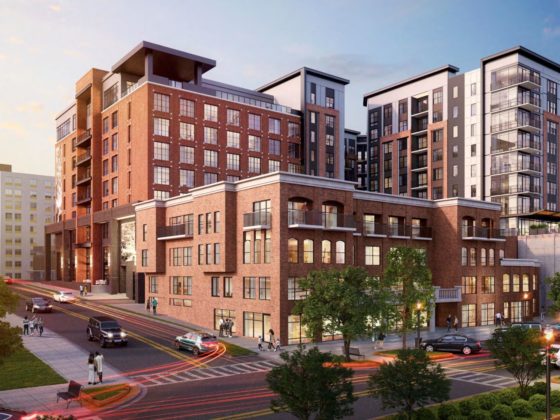
The redevelopment of Drayton Mills and the surrounding neighborhood continues to take shape and points to how developers are reimagining this historic Spartanburg community.
The prospect of bringing new life and vitality to an area that has played such an important role in Spartanburg’s cultural and economic history is exciting, according to Jennifer Calabria, director of land development for Pacolet Milliken.
The company manages a portfolio of land holdings across the region totaling more than 26,000 acres. Among those holdings are properties centered on Drayton, and the company is working with CBRE senior associate Brian Scurlock to develop projects that will further develop and redefine Drayton and Spartanburg’s east side.
So far, the mill and the 16 acres on which it sits have been redeveloped into luxury loft apartments and a thriving community of retail shops, offices and restaurants. The redeveloped mill, according to Calabria and Scurlock, is envisioned to be the central hub of a new, modern Drayton community with its own distinct identity, rather like Atlanta’s Buckhead.
As part of that strategic vision, Pacolet Milliken donated property near Mary Black Hospital to Spartanburg School District Seven, which subsequently built a new Drayton Mills Elementary School there. Dan Ryan Builders is developing the Trailside at Drayton Mills neighborhood centered on Dalmatian Drive behind the school, and Calabria says this is an important part of bringing new life and identity back to Drayton.
 “We knew it was a special community … and we wanted to do something to help it, revitalize the area and figure out who it wants to be and what it wants to be,” Calabria says.
So far those efforts amount to between $150 million and $200 million in investments by Pacolet Milliken and others to bring new life to Drayton. The next phases will involve bringing more retail options to a 6-acre parcel across Drayton Road from the mill and developing more housing options along Floyd Street behind the mill where Pacolet Milliken owns about 170 acres of undeveloped land.
“We’re trying to create a critical mass,” Scurlock says. “We want Drayton to become less of a pass-through and more of a community destination.”
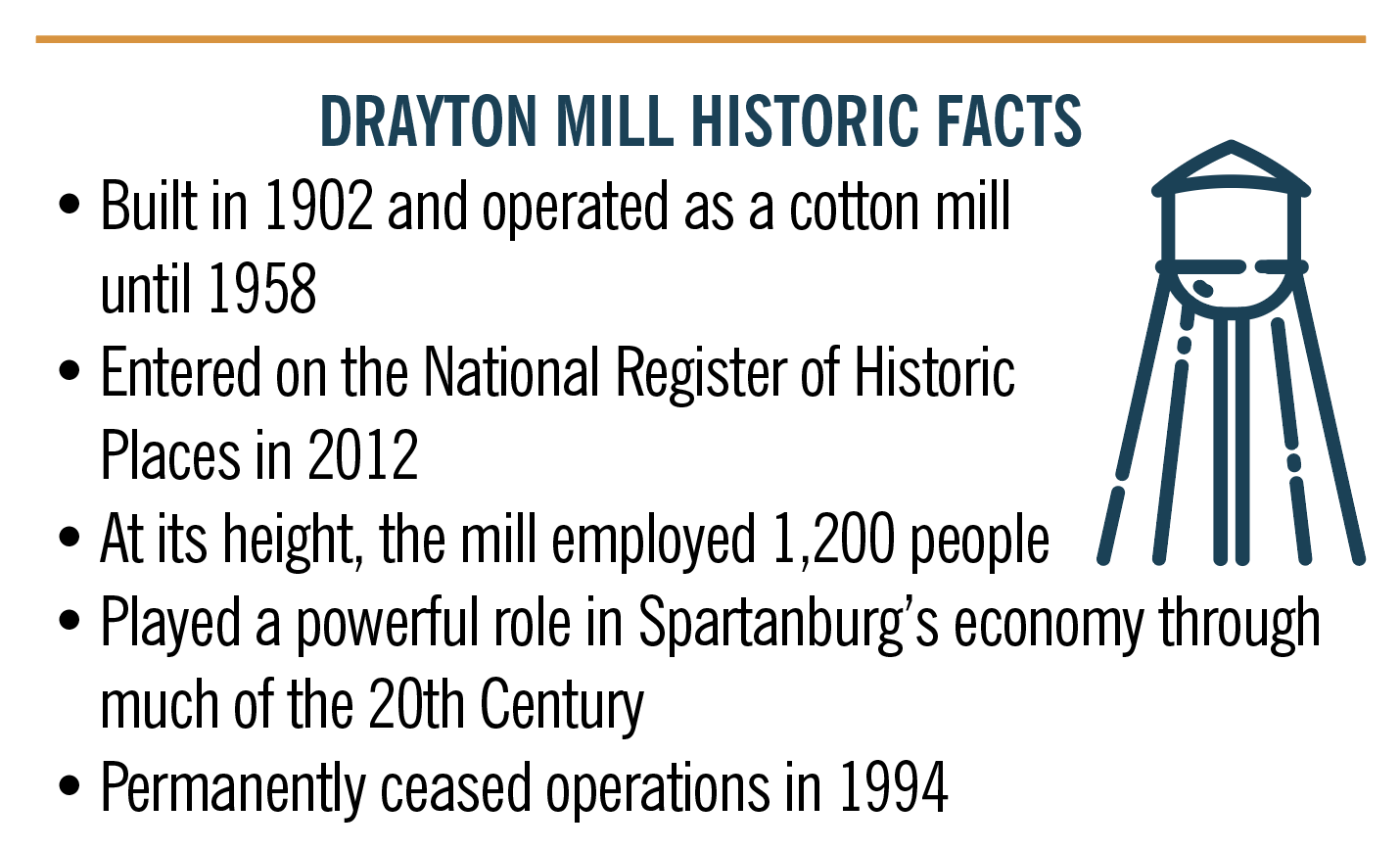
- Built in 1902 and operated as a cotton mill until 1958
- Entered on the National Register of Historic Places in 2012
- At its height, the mill employed 1,200 people
- The mill was designed by Lockwood, Greene and Co. of Boston and Spartanburg and is an example of a Romanesque Revival-style design
- Played a powerful role in Spartanburg’s economy through much of the 20th Century
- Permanently ceased operations in 1994