
Retired Miami-Dade Police Department Sgt. Sean Holtz said he truly loved serving the people of his Florida community for 30 years.
“Most of my career I was a uniformed, street police officer, and that’s what I loved,” he said. “I knew I was making a difference, helping people who needed help, and I enjoyed it.”
So in 1999 when Holtz launched the baseball stats website that would eventually become Baseball-Almanac.com, he thought of it as a hobby — a way to ease the stress that comes with policing.
“When the world wide web began … I decided to throw up the page ‘Our National Pastime,’ which won an award from AT&T for best sports site,” Holtz said.
A year later, “Our National Pastime” had morphed into Baseball-Almanac.com.
“It was a great escape,” he said. “It was never meant to be a business.”
And yet it has become a business: an online archipelago of baseball stats, stories and lore where baseball fans can, and do, get lost for hours.
Holtz said the site saw 730,000 page views and almost 110,00 unique visitors per day in June and is generating revenue through third-party advertising.
“On any given day, there’s probably 3,000 to 5,000 companies advertising on the site,” Holtz said.
Traffic tails off a bit during the offseason to about 500,000 page views daily, he said.
Experience America’s Pastime through Baseball Almanac
 From the homepage, visitors can dive into any number of baseball-related topics, from the history of the All-Star game — including every box score and lineup dating back to the first game in 1933 — to an alphabetized list of player obituaries, including their playing stats.
Pages are peppered with interesting quotes, data visualizations and trivia, all from the mind of a man whose love of trivia and knowledge is matched by his love of baseball.
“I never wanted this to be a baseball stats site, I always wanted it to be a baseball history site,” Holtz said. “But it’s the stories behind the stats that compel me.”
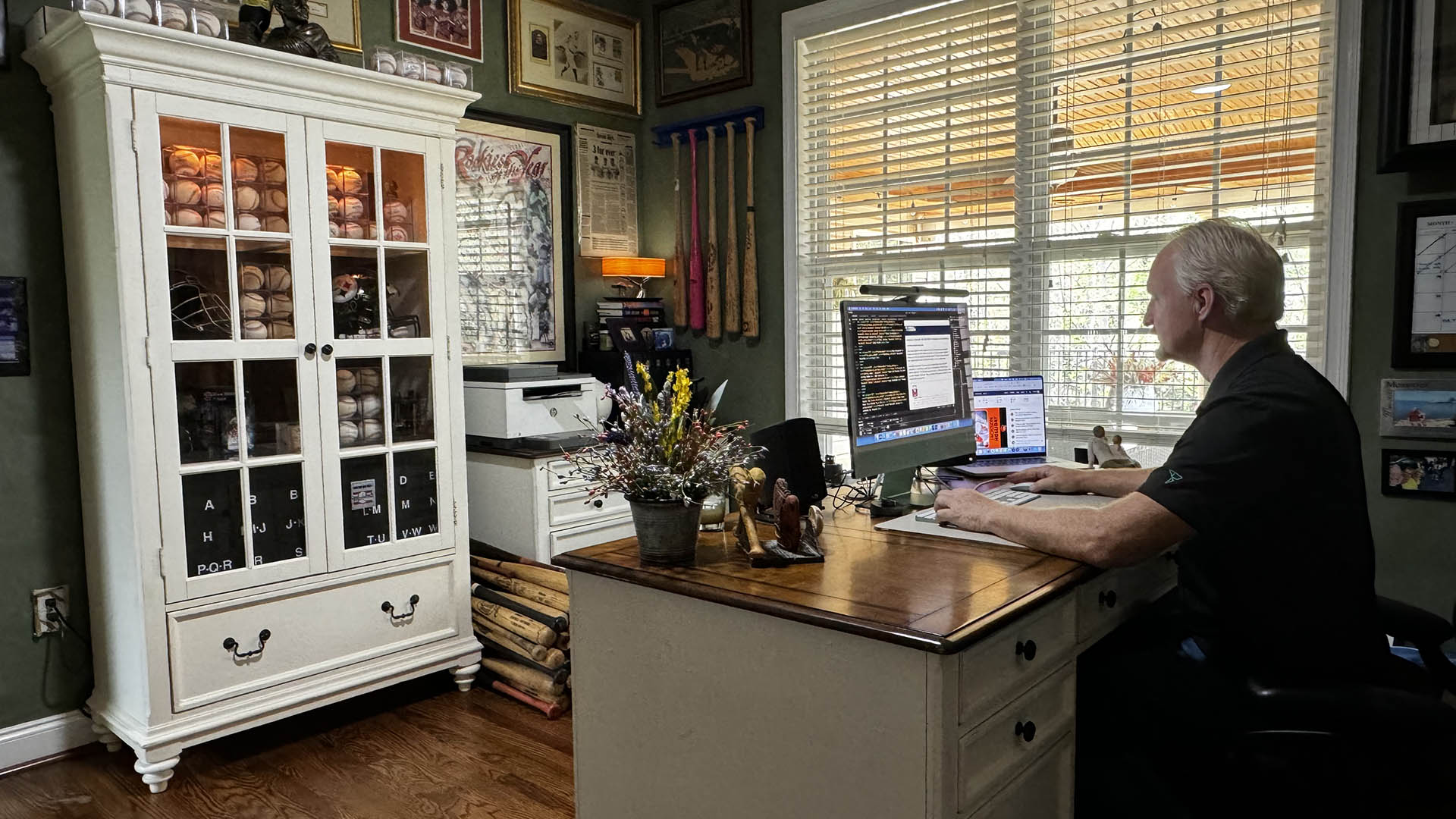
Holtz retired from the force in 2017 and moved to Greenville three years ago. During baseball season, he rises at 4 a.m. and, using a complex back-end system he built with the help of his programmer, processes stats from the previous night’s Major League Baseball games.
“There are no off days during the season,” he said.
He plows all the revenue back into the site, which he says remains a passion project.
“But, yes, it’s definitely a business, too,” he said, chuckling. “My accountant reminds me of that all the time.”
His latest opus: cataloguing every baseball card in the history of baseball cards.
“And I just launched an umpire’s page last month, tracking where they umpired by date, and whether they were calling balls and strikes, or working in the field,” he said.
Holtz said he gets a few offers to sell every year, but he’s never been tempted.
“I have an insatiable thirst for knowledge, for trivia and unique items of interest, for stories about people,” he said. “Baseball is about so much more than just statistics. It is history, our history — American history. And as more and more players come from other parts of the world, it’s even woven into world history.”