
How locally launched technology platform Veteran One helps former service members become informed, empowered and employed
Imagine if your newest hire brought the kind of can-do, relentless spirit to the office every day that the brave men and women of the U.S. military bring to their charge of defending our country.
Good news:
There’s a workforce, and visionary platform, for just that — and the powerful potential for employers is matched only by the positive impact on veterans.
“We connect veterans to employers who recognize the benefit of hiring veterans, with substantial advantages for the companies who employ them, including strong leadership, training and other skills — without the usual costs associated with the hiring process,” says Tyler Warren, president of Veteran One.
Co-founded by Warren and Neil Johnson, both veterans themselves, Veteran One is a tech company that promises brighter futures and meaningful careers for our country’s servicemen and women upon their return home. The fast-growing platform nurtures veterans’ potential in their new role as civilians while helping corporate America find its future leaders through prepared and properly placed veterans.
Veteran One’s unique survey platform includes a 50-question, in-depth skills assessment that matches veterans to career paths and potential job opportunities through an individualized profile. These profiles demonstrate how a veteran’s innate abilities and skills translate to non-military positions.
“I got out of the military in 2013. I’d been married five years and gone on two deployments,” says Warren. “After I graduated from Clemson, I went to Afghanistan with the 82nd Airborne — but I never wanted to make it a career. My last day in the Army was my first day [working] at Johnson & Johnson. But that was a very deliberate transition — it required a lot of preparation and planning, and I assumed that’s what everyone did when they left the military.”
When Warren moved to Greenville to pursue an MBA from Clemson, he ran into a veteran nonprofit that was trying to help veterans transition.
“They didn’t have much of an employment program — I said, ‘Guys, employment is the key to a successful transition.’ Without employment, these veterans are just transitioning to [another type of] dependence on the government,” says Warren. “What if they’re not trying to live off of the VA?”
From Warren’s perspective, providing veterans with employment opportunities can serve as a springboard to solving other problems inherent in the transition from military to civilian life.
“They need to be empowered and given an opportunity from an employment perspective,” he says. “I believe employment can address many other important issues, like housing, mental and financial health, and transportation. Most of these men and women are wired to have a purpose behind what they’re doing. So if they’re unemployed or underemployed when they get out of the military, it can be devastating to their mindset.”
From learning how to dress for interviews, to networking tips and building a resume and LinkedIn presence, Warren went from helping 84 veterans get hired at a “shoestring” nonprofit in 2018 to now serving thousands at Veteran One. He credits much of the organization’s growth to his business partner, Neil Johnson.
“He’s our visionary and capital funding source,” says Warren. “He saw the impact I was making at the previous non-profit.”
But because Warren didn’t yet have the team or the financial assistance to build out the employment platform, Johnson started directly investing in Veteran One until the organization had the resources needed to scale the operation.
“This is how we go from serving 84 veterans in a year to 8.4 million,” says Warren. “Our technology builds the resume for the veteran. It’s more than a tool; it’s an aggregator of resources [for job-seekers] too.”
Since then, the team has brought on George Pegues as CTO to lead Veteran One’s technology efforts, followed by Berno Lans, software developer, to fuel growth even further.
Those advances in workforce development also pay off in significant benefits for Upstate employers.
“We’re cutting out the middleman. There are a lot of costs associated with the traditional hiring process, which Veteran One simplifies and streamlines,” says Warren, adding that the platform makes it easy for both employers and pre-vetted candidates to track their status in the hiring process, schedule video meetings, accept an offer letter and more.
“So if employers don’t have their own hiring software, we provide that value,” says Warren. “Additionally, you’ll find that these veterans are going to be highly qualified and driven. The platform is free for the veteran, but they have to earn it. There’s a profile they have to build and an assessment they have to take before they have the opportunity to match with the employers. So you get really motivated individuals.”
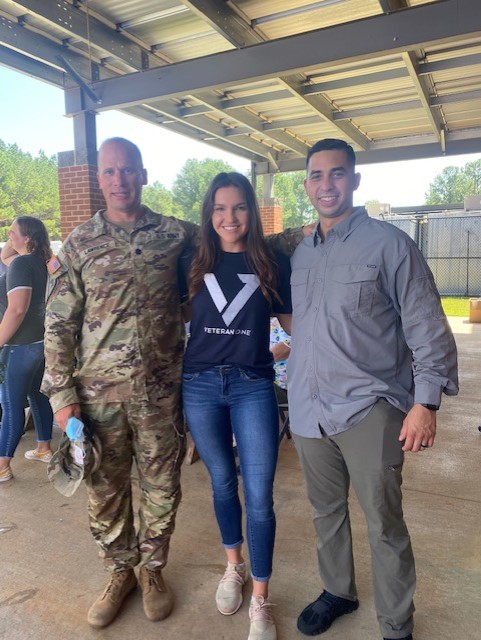 Early on, when he first started working with veterans, Warren would hear them say the same thing.
“’I don’t know what I can do and I don’t know what I want to do,'” he says, repeating the concerns he would hear from veterans. “‘The military recruiter signed me up for something that I did for four years, but I’m not interested in doing that anymore. And I have no real-world experience. Help me understand what comes next.’”
That insight led to another free feature of the Veteran One platform: a personality and aptitude test veterans can use to find their best career fit — and even discover new career fields in which they could pursue work or ultimately decide to study in college.
“We have employers using our platform all over the Southeast and a few across the country,” says Warren, hinting at big things to come. “But we’re still in development — working on a few features that will blitz-scale the platform. The vision is to be the next Indeed for veterans or Google for veteran job searches.”
 To learn more, visit veteranone.com.





