Do eat with your hands when you’re supping with Afghan nomads in their tent. Don’t forgo utensils the next evening when you’re dining with high-ranking officers, diplomats and visiting dignitaries in the Ambassador’s residence.
Those aren’t military regulations — that’s just the stuff of business etiquette. While most of us likely won’t encounter such social situations, Caroline Buxton Avinger once had a Defense Department client who did.
Manners matter
Today, as owner of Protocol SC, she helps professionals of all stripes navigate the do’s-and-don’ts of corporate behavior.
“Most people think business etiquette, ‘Oh, well, that’s just manners,’ and that’s a part of it but it’s definitely not the whole picture,” says Avinger, who started her Greenville company a dozen years ago. “It’s more professional presence, presenting yourself in a way that aligns with your skills and your role in a profession.”
She recalls a client in Texas, an automotive-financing company whose employee dress code required dark suits with white shirts. But when the salesmen would visit small-town dealerships, their customers, she says they told her, would “‘tend to withdraw from us because we came in so Wall Street, powerful corporate and it’s intimidating.’”
Proper etiquette, she says, would suggest you simply take off your jacket and roll up your sleeves.
 “You don’t necessarily lose your corporate identity, but you’ve got to make some accommodations for the person sitting across from you, so that you make them feel more comfortable,” she says.
Another client, an attorney, once told her he takes prospective hires to lunch to watch the person’s comportment.
They may look great on paper, but if the guest doesn’t demonstrate crucial corporate soft skills — don’t order the surf-and-turf! — that could reflect on the law firm’s brand.
“’They’re going out to face our clients. They’re representing us and they’re not presenting an image that we want to present,’” she says.
Dress the part
Clothes can close the deal — or, at least, get the business at hand down to business.
“It’s like a shortcut to getting along with someone,” says Stephanie Goodale, general manager of the Commerce Club downtown. “It just kind of cuts through all the BS, so to speak. You know right away that that person is valuing your time and probably taking care of their business responsibilities.”
Business etiquette has changed over the years. No modern-day Don Draper (of “Mad Men” TV fame) would offer a cigarette. Dress styles have changed, too — think Casual Fridays and ladies’ once-de rigueur hats. And then, of course, the pandemic.
“People have to put real pants on again,” she says.
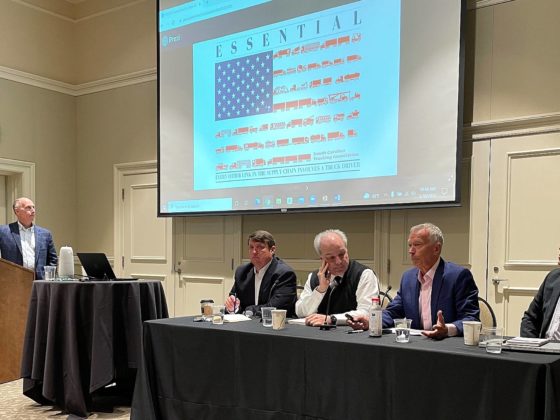
 Joel Douglass took a refresher course several years ago with another coaching company in Greenville. Although he has spent nearly a dozen years traveling in his role as senior director of sales for national accounts at ScanSource, he says he recommends these programs.
“Odds are you probably making a mistake and you just don’t even know it,” he says.
He also says that while business etiquette promotes confidence, the polish also helps build relationships with current or prospective customers.
Or, as he puts it, “If you’re presenting something or you’re trying to communicate an idea to them, they can trust you.”
Etiquette gold is more than silverware
Caroline Buxton Avinger, owner of Protocol SC, offers several tips, among them:
- “Please” and “Thank you” — simple, but not simplistic. These go a long way toward creating a positive business interaction with co-workers, customers, employers and employees.
- Be punctual. Be mindful of others’ time and don’t start an encounter on the wrong foot by having to apologize for being late.
- Pay attention to the people you are with. Glancing around, mid-conversation, to see who else has entered the room or taking a peek at your phone during a meeting sends the message that the business at hand isn’t important.
- Dress appropriately. Know the dress code and follow it. Unless you are in the fashion industry, most employers aren’t concerned about you expressing your individuality through dress. They want to know that you can be a professional, which means dressing the part for the job you have, as well as the job you want.
Dining’s Do’s and Don’ts
Stephanie Goodale, general manager of the Commerce Club, serves up these bite-sized bits of business-dining etiquette:
Do:
- Stand to greet your guest when they arrive. Not only is it good manners, it’s just welcoming.
- Follow the cues of your server if you are uncertain, they are trained experts.
- Communicate your needs/wishes. Hospitality is customizable and it’s all about you and your guest’s comfort.
Don’t:
- Fixate on small details like which fork to use. We are happy you are using a fork, and we are always happy to bring you another.
- Pretend the server is not there. Acknowledging their presence shows you have manners for everyone and will make your guest more at ease.
- Be afraid to ask questions. Vulnerability is an endearing quality.
Stay Grounded Up in the Air
“An airplane is actually a business setting, it’s not a social setting, because you’re in a transactional environment where everybody is getting from Point A to Point B. Even on vacation, that’s a business situation,” says Caroline Buxton Avinger, owner of Protocol SC.
She sees issues on airplanes stemming from some peoples’ dismissiveness and lack of giving others their due dignity.
“I think that’s why you see people on planes misbehaving — because it’s about them. It’s not about anyone else. And you see that in business transactions, as well: ‘It’s about me not about you.’”