If you’ve spent enough time on the internet shopping, filling out forms, taking surveys or a plethora of other things, you’ve no doubt come across the dreaded CAPTCHA.
A CAPTCHA, or “Competitively Automatic Public Turing test to tell Computers and Humans Apart,” are those little quizzes that users must fill out in order to prove they’re not a robot. They’re designed to block spam bot activity, ensuring individual users are who they claim to be.
It’s a facet of the digital age that has become the focus of Ellipsis, a Greenville-based tech company run by Bill West, a veteran of the telecommunications industry.
Many people fail CAPTCHA tests
Sometimes it’s as simple as clicking a box that says, “I’m not a robot.” Other times you may have to transcribe some squiggly words into a box. You might have to point out which sections of a photo grid contain street signs, or pick the drawing of an animal that is right-side up.
Beyond his own personal run-ins with them, West hadn’t put much thought into CAPTCHAs, until one day when he was chatting with a friend of his who owned an e-commerce company.
“My friend told me one night he was trying to buy something off his own site, but his wife had accidentally taken his reading classes with her when she went shopping,” West said. “He said that without his glasses, he couldn’t even get through the CAPTCHA to buy something, and he owned the site.”
It got West thinking. If the owner of a company couldn’t get through his own CAPTCHA, what were the odds others had the same problem?
After parsing through the data, they learned anywhere from 3-4% of users were leaving the site the moment they saw a CAPTCHA. Most remarkably, about 30% of people were failing on the first attempt, a majority of whom then gave up and left the website as a result.
“We realized we needed to find an alternative,” West said.
Annoying? Maybe. Necessary? Absolutely.
While often annoying, CAPTCHAs protect against many types of bots, including “sneaker bots,” so named because they were originally created by scammers to buy out limited-edition Michael Jordan sneakers. These bots can wipe out an e-commerce site’s entire inventory in a matter of seconds, leaving real customers empty-handed.
But given that CAPTCHAs can also steer real customers away, West and his team at Ellipsis developed a methodology by which they track the timing and movement of 53 different behavioral events within a web browser.
To put it simply, they measure all the things most people would never consider. Time between keystrokes, for example. How long someone holds down a key and lifts up their finger. Mouse movements, including arc and speed. Touches and swipes on a phone screen. Length of swipes. Length of touch. The smallest of details – at a scale impossible for a bot to spoof – that reveal our humanity.
These measurements allow Ellipsis to not only use checkout protection to block bot purchases, but also to protect companies from “form spam,” which are those junk messages that clog up email listing sign ups, product review sections and comment forums.
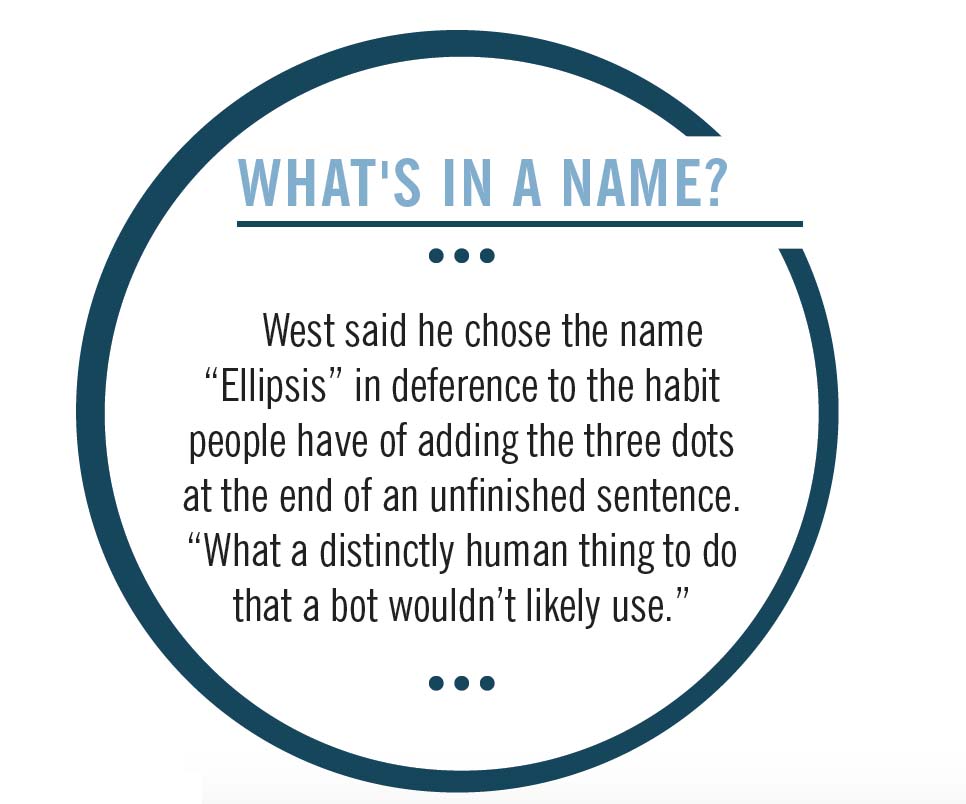 “We block all that, which frees up a person who otherwise would’ve had to go through all that manually,” West said.
Ellipsis will soon be launching charge-back protection as well, to protect companies from fraudulent disputes and prevent losses. But perhaps the most surprising implementation of the tech is the way it can identify an individual.
“I was just looking at my own data, and I realized my keystrokes and measurements all had a very tight range that didn’t vary,” West said.
That means even real people who are using someone else’s login information could feasibly be stopped in their tracks and forced to answer a confirmation question via two-factor authentication.
Beyond fraud protection, West is now exploring ways to use the technology as an early warning sign for those with PTSD or neurological degeneration like Alzheimer’s. If the earliest symptoms of those conditions can be found via the smallest of keystroke differentiations, it could give patients a jumpstart on treatment by years.
For now, the goal is to keep seeing where the technology takes them.
“We’re constantly adding things,” West said, “and constantly upgrading as we go.”