

Mario Brown talked about the second-degree burns he sustained on his right side when he rolled off a bed onto a space heater. He was less than 2 years old then, living with his grandmother, an amputee, in an apartment he described with an off-color depiction.
The people there, he said, “were disconnected from the system, disenfranchised, ignorant of how the system worked, thought they would get in trouble if they took me to the hospital. They didn’t. A neighbor called it in.”
Brown went on to live in orphanages and foster homes. Today, he is co-founder and managing principal of Affordable Upstate, billed as a “regional multifamily investment firm.”
Launched in 2017, the company purchases and redevelops “existing naturally occurring affordable housing.” Those properties include rundown apartment complexes that are all but unlivable, Brown said.
“For me, what I get to work on every day is really the situation that created me,” said Brown, a former football player and commentator who worked for a homebuilder from 2013 until he started Affordable Upstate with Brian Albers.
Albers, who worked for the financial services firm Raymond James from 2007 to 2018, is a partner in the company.
“What we’re trying to do is just preserve the affordable housing that our community has,” he said, echoing what Brown said about Affordable Upstate’s work.
 From 2017 to 2020, the company bought sites for $25,000 to $75,000 per unit, then spent as much as 40% of the purchase price on renovations. A unit costing between $12,000 to $15,000 to upgrade would then rent for $850 to $1,050 a month, Brown said. Affordable Upstate owns and manages those properties.
The co-founders said the business model wouldn’t work without incentives.
South Carolina’s Housing Tax Credit Program, which the state hails as “the country’s most extensive affordable housing program,” provides for-profit and nonprofit organizations with dollar-for-dollar reductions on their federal income tax liability for qualifying properties, according to the SC Housing website.
Likewise, the city of Greenville’s special tax assessment for affordable housing offers a freeze of property tax assessments — at the property’s pre-rehab value — for up to 20 years.
“We believe incentives like that and others that are out there allow us to do some good while doing well for us and our investors at the same time,” Albers said.
Eric Morris concurred. A financial adviser and managing director at Cary Street Partners, Morris is among nearly 100 investor partners in Affordable Upstate, which now boasts $160 million in assets, including 1,450 units in 24 communities “stabilized” across the Upstate.
Investors see yearly average returns of 16%, with 6% of that coming from affordable-housing incentives, he and the others said.
But wouldn’t taxpayers perhaps chafe at tax-subsidized “affordable housing” when investors are making a profit?
“Businesses have a way of being very efficient and effective with their capital-allocation decisions; government, not so much,” Morris said.
James Christopher Heard, another investor, agreed.
“You have to have investors to make causes happen,” he said. “We can’t wait on government. Think about green energy, solar panels. There are people making good money manufacturing the panels and installing them while society gets carbon-free energy.”
 Morris noted that the government would spend $20 million to build or manage 200 new units, while the private sector could build or manage 1,000 to 2,000 units for the same amount.
“Same dollars spent, much bigger impact,” Morris said. “What Mario and his team have done in the niche of affordable housing is remove the stigma associated with affordable housing and make it investable for the private sector.”
The two entrepreneurs and the two investors all see the business enterprise as a win-win-win:
- Tenants can afford clean, well-maintained housing units with quality amenities. Cable and internet are offered at deep discounts.
- Investors get a return on a real estate investment with tax advantages.
- Taxpayers get service workers and first responders who don’t have to worry about shelter, and properties that were once neighborhood eyesores increase property values.
Brown pointed out the market should remain robust.
“There’s more demand for existing products,” he said, “because you can’t create new supply that is paired with the incomes of today.”
Affordable housing. Workforce housing. Moderate-income housing. Whatever you call it, Affordable Upstate offers housing to a target market that includes the likes of service workers, teachers, police officers and firefighters, whose incomes are 40% to 70% of area median income. (tax incentives also include regulations about who qualifies as a renter).
In South Carolina, the average yearly base salary for a police officer is $59,200, about $5,600 more than that of a schoolteacher and roughly $17,500 more than a firefighter’s earnings, according to Indeed and Salary.com, as of last June.
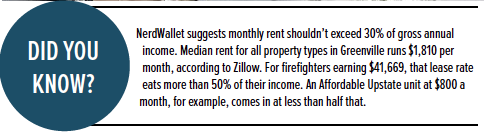
NerdWallet suggests monthly rent shouldn’t exceed 30% of gross annual income. Median rent for all property types in Greenville runs $1,810 per month, according to Zillow. For firefighters earning $41,669, that lease rate eats more than 50% of their income. An Affordable Upstate unit at $800 a month, for example, comes in at less than half that.
“We’re talking about people who would struggle with shelter costing 25% to 30% to 40% of their monthly or yearly income,” Brown said. “The byproduct of it is, in my mind, a workforce that is engaged, motivated and wants to make an impact.”
With a mission to bring “modern, energy-efficient, affordable living to the Upstate of South Carolina,” Affordable Upstate has grown to include:
- $160 million-plus in assets
- More than 1,450 units across the Upstate
- More than two dozen “communities stabilized”
- Nearly 100 investor partners
Source: Affordable Upstate





