
Like any good investor, Larry Webb always does his homework before diving into a big new project.
There’s the usual data to pore over: census figures, area demographics, zoning due diligence, market trends, and so on.
But when it comes to the planned transformation of the old Piedmont Mill Village, a portion of which Webb is personally financing himself, the prime motivating factor had nothing to do with numbers.
Instead, it was a car full of young people that sealed the deal for him.
“I live in Piedmont, have for years, so I’m very familiar with the area and the history of the mill,” Webb said.

Anyone who has ever drifted lazily in a kayak down the Saluda River is likely familiar with the site of the former mill village. The historic mill building, Piedmont Number One, was built in 1873 by Henry Pinckney Hammett of the Piedmont Manufacturing Company. As the years went by, another mill, Piedmont Number Two, was built across the river, and the company became one of the world’s largest textile mills and a leader in the global industry, with four mills running simultaneously.
The spinning of the mills’ 5,000 spindles and 112 looms spurred a hub of commercial activity, and thus the Piedmont Mill Village was born.
But that once-thriving village has now fallen silent, after the mills shut down in 1977 and Piedmont One burned down in a fire five years later. All that remains now is the old smokestack, a monument of a lost era.

The right track
It just so happened that Webb was standing in front of that old smokestack a few months ago when a car full of young people pulled up and came to a slow stop behind him. The strangers got out and asked Webb what he was up to.
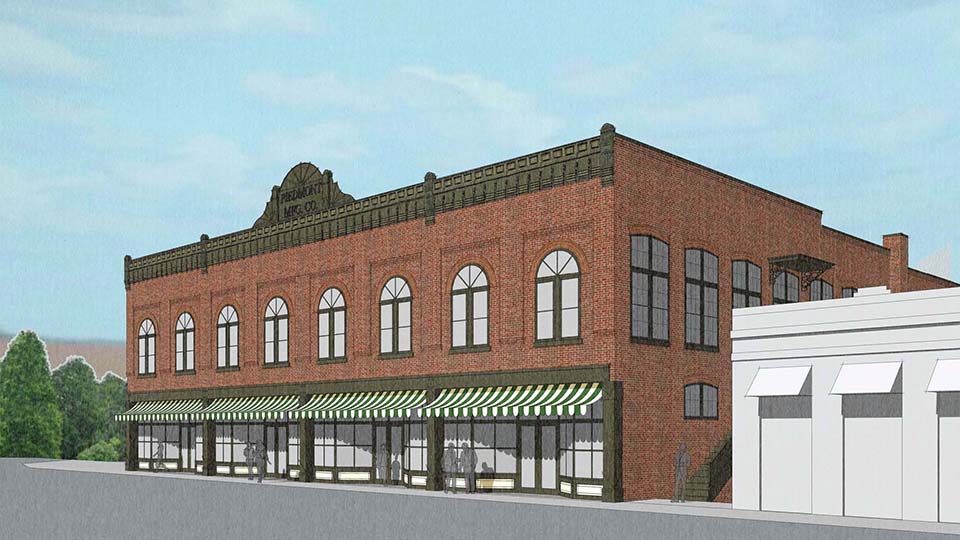
He told them his plans to transform the old Piedmont Manufacturing Mercantile Building into a commercial hub, restoring it to its original purpose. The building, also referred to as a community store, was built in 1905 but has sat languishing for years.
“Larry told me about this moment, how the girl in the car mentioned that they were so glad to hear it,” said Greenville County Councilman Lynn Ballard, who spoke with Webb shortly thereafter. “The young people told him, ‘Several of us are really interested in moving to Piedmont because we can afford it, since it’s much cheaper than Greenville,’ but they said they wanted the amenities young folks want — coffee shops, restaurants, cafes.”
That moment was all Webb needed to know he was on the right track.
“I’d already thought this was a beautiful building,” Webb said. “I’d talked to business leaders, the Lions Club, Rotary Club, and everyone said that if we can get downtown back to life, it would be a tremendous boon to the community. Now we’re fully committed to making it happen as soon as possible.”
But despite his urgency, unforeseen roadblocks have led to the project being one year behind schedule.
Webb purchased the mercantile building back in 2018 and spent 18 months going through the historical tax credit qualification, an arduous process requiring him to get the building on the historic register. Once he was finally approved, he went through the redesign process, making sure the building met all the criteria the state and federal government require to get the building back to its historic condition.
Meanwhile, Webb worked to get pre-lease agreements for more than 65% of the space, with plans for a tap house, a coffee shop, a restaurant, office space and an art gallery, with apartments planned for the second floor.
Construction was all set to begin in March 2020, with occupancy planned for spring of 2021.
“Then the virus hit,” Webb said. “We decided it wouldn’t be wise to begin the restoration of the building and get it ready for occupancy if businesses weren’t allowed to operate, so we put a temporary moratorium on the restoration to wait out the virus.”
Now the restoration is set to start on a new timeline, beginning late spring, with occupancy by the spring of 2022.

A riverfront community
The restoration of the old mercantile building is one of two major projects ongoing in the old mill village. Developer Brad Skelton, of Red Oak Developers, is also working on building a riverfront community of townhouses in the spot where the old mill buildings once stood.
Plans are still preliminary, but discussions have been about the project featuring a new brewery, retail space, green space and as many as 60 townhouses.

Kayak access via a dock is also part of the plans, as is a pedestrian bridge where the old steam pipe once crossed the river behind the waterfalls, creating “pedestrian connectivity between Anderson and Greenville counties,” according to Webb.
“You’re going to have people now able to come back down to Piedmont to grab something to eat, grab a beer, hang out,” Webb said. “There’s going to be a lot of public interaction, so five years from now, we envision downtown is going to be the center of activity in Piedmont once again.”
Did you know?
- The old historic mill building was built in 1905
- Four mills ran on the Saluda River in Piedmont for decades, beginning in the 1870s, creating a hub of activity, including office, retail and a village area
- Piedmont Mill Village shut down its mills in 1977
- The original mill building caught fire and burned down in 1982
- The mercantile building restoration will be complete by spring of 2021
Correction: a previous version of this story stated that developer Richard Greer, of State Investors, was involved in the riverfront community alongside Brad Skelton. We have since learned that Greer passed away in November. We apologize for the mistake.





