
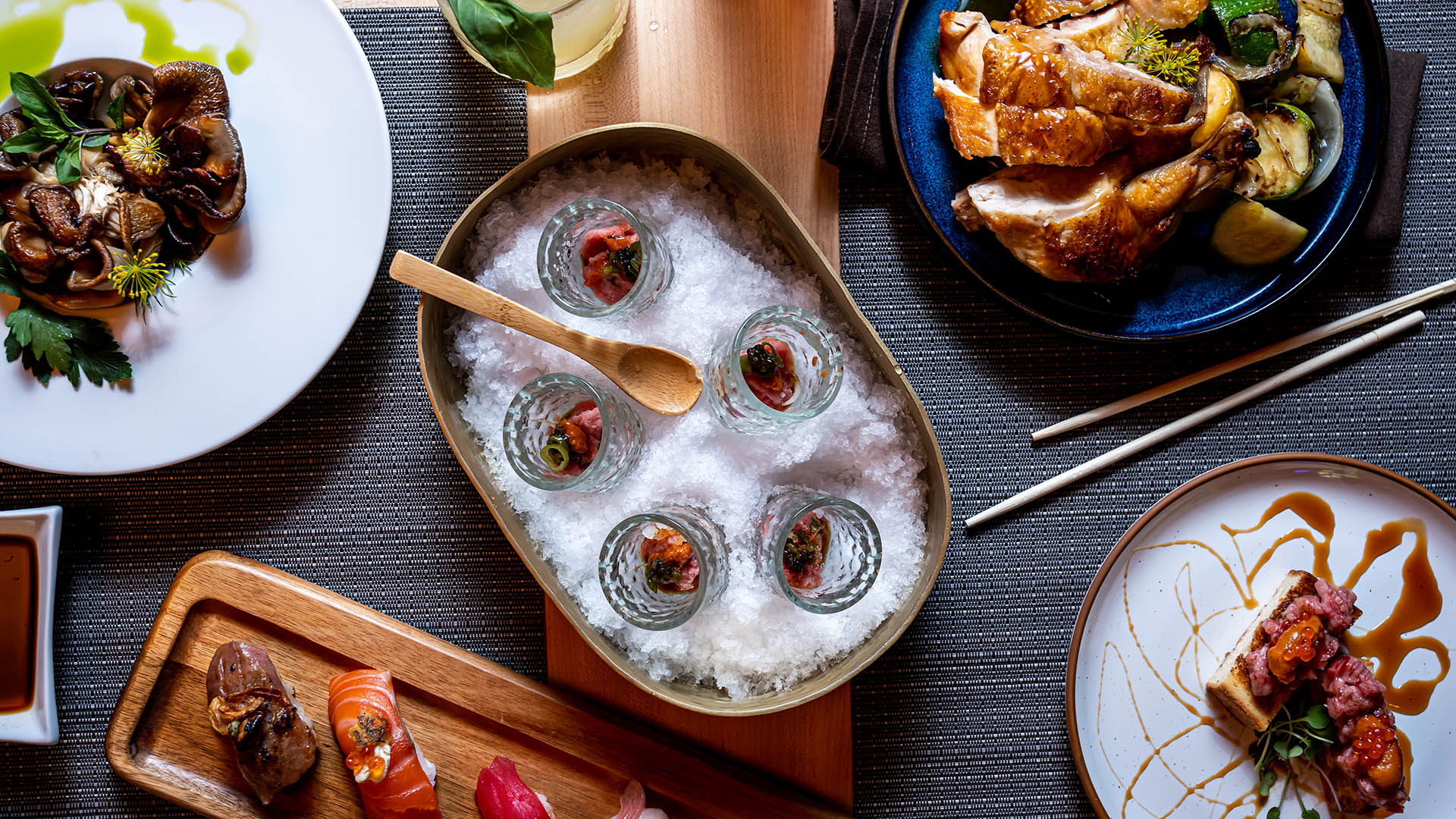
Steve Palmer admits it was not a particularly convincing sales pitch that led to the opening of the new downtown Greenville restaurants Indaco and O-ku.
Both eateries, which opened at 40 W. Broad St. in front of the Courtyard by Marriott overlooking Main Street, are under the umbrella of The Indigo Road Hospitality Group, the Charleston-based restaurant group Palmer founded and now runs.
Unlike its other eateries, however, Indigo Road did not launch the concepts on its own.
The restaurant group currently operates concepts as far north as Washington, D.C., and as far south as Jacksonville Beach, Florida, but Palmer initially had no plans to open restaurants in Greenville so soon.
So when he got a call from the team at Windsor Aughtry Co., the Greenville-based developer that owns the Village Green space, he told them it was not a good time.
“They reached out and said they have this space and asked if I would be interested in leasing it,” Palmer recalled. “I responded by saying, ‘Look, I love Greenville, but I don’t have any money right now.’”
Palmer also told Windsor Aughtry the restaurant space wasn’t right for him. The space, which previously housed Rick Erwin’s Nantucket Seafood, was roughly 8,000 square feet, about double the typical size of Indigo Road’s restaurants.
“So here I am, a complete stranger to them, and I said, ‘Sure, I could do a restaurant, but I have no money to do it, and also we need to do two restaurants in that space if we did do it,’” Palmer said. “They said, ‘OK, we’ll get back to you.’”
That was the start of a partnership that is not only unusual for Palmer and Indigo Road but also for the restaurant space in general. Rather than simply leasing out the space, Windsor Aughtry partnered with Indigo Road on the two new concepts.
The developer-restaurateur partnership pays off
Based on the early response from the community, the partnership seems primed to pay off.
“This is our first true investment in a restaurant concept outside of traditional real estate leases,” said Kirk Crawford, principal with Windsor Aughtry. “And so far, things have been great — honestly better than we hoped.”
To be clear, this is just one single deal, far from representative of the industry as a whole. Palmer is quick to admit the arrangement is “certainly not common.” But both Indigo Road and Windsor Aughtry see it as a viable model moving forward as more mixed-use developments, especially those in urban cores, rely on anchor restaurant tenants to drive activity.
“I think real estate developers are getting more creative about how to structure a deal, how to finance a deal, because let’s be honest, construction costs have never been higher, real estate has never been more expensive, the cost of borrowing capital has never been higher,” Palmer said. “So getting deals done right now, getting projects off the ground, requires you to think differently.”
On the developer side, the restaurant space also presented an opportunity.
“To put things in perspective, for us as hotel developers, it’s a lot easier to swallow a $3 million to $5 million restaurant development that, quite frankly, can potentially generate just as much income as a hotel, as it is to build a $30 million to $50 million hotel, especially with construction costs and interest rates where they are,” Crawford said.
Palmer and Crawford agreed it was a deal mostly predicated on trust.
“Ultimately in these partnerships, the real estate developers are coming to us because we’re the operations guys, so I think you’ve still got to feel like you’re in control of how a restaurant in going to run, because that’s what you’re there for,” Palmer said. “So I think the most crucial part of doing something like this is making sure you’re aligning your values and that the people you’re doing business with feel the same way.”
As in any business, it’s all conditional. Palmer said he understands why such an arrangement might not be replicated.
“If somebody said, ‘I don’t want any partners. I want to call all the shots myself,’ I totally understand that,” Palmer said. “But these days especially, I do think there are a hundred different ways to skin a restaurant deal.”





